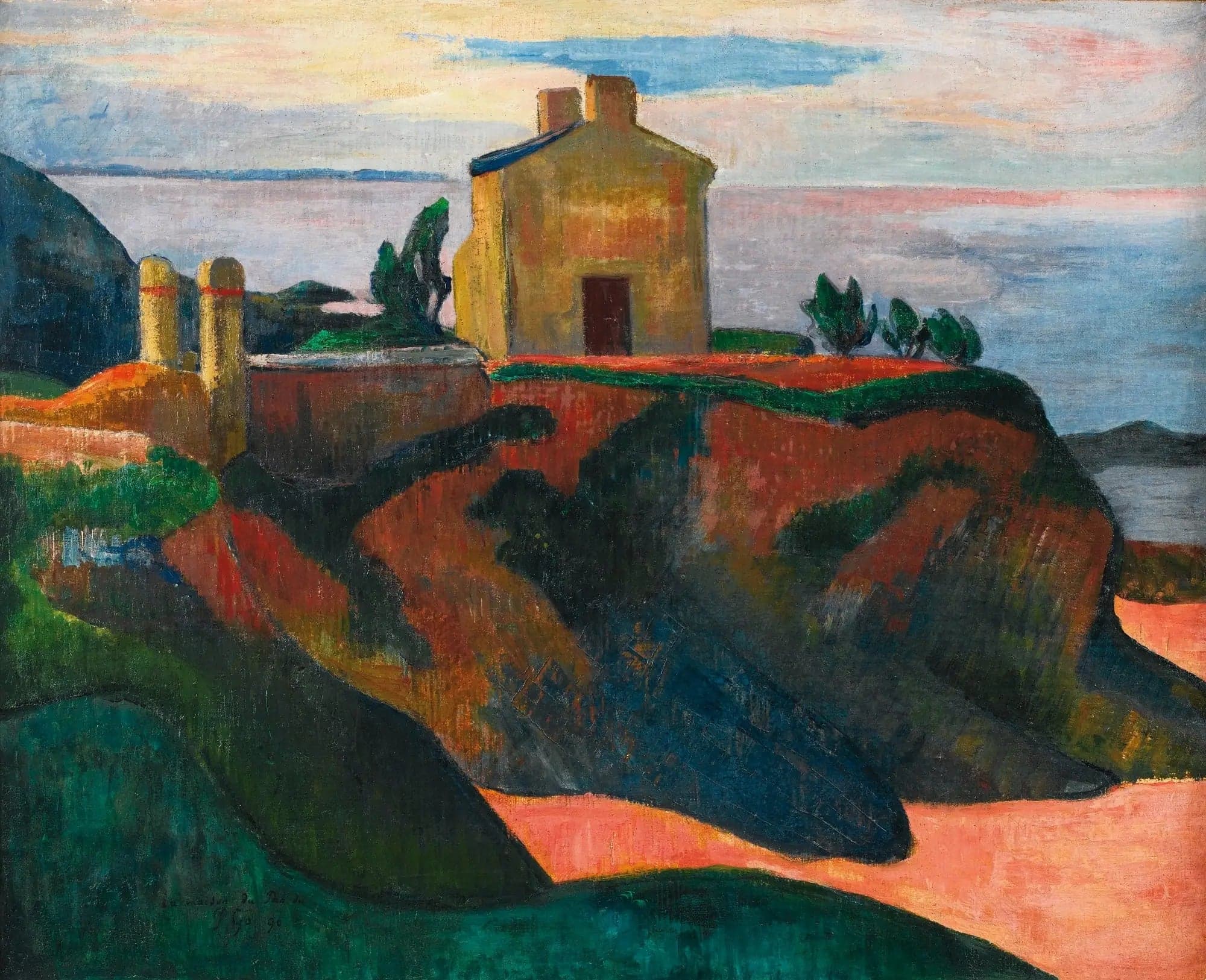
The House of Pan-du
- Original dimensions
- 61.1 x 50.3 cm
- Museum
- Not specified
- Year
- 1890
Scene depicted
This masterpiece transports us to a universe where rural architecture blends with the serenity of the Breton landscape. On this canvas , the house of Pan-du reveals the contrasts between deep shadows and vibrant lights. The buildings, almost hypnotic, stand out against a backdrop of tender greenery, promising delicacy and refuge. This pictorial work invites the viewer to explore a suspended moment, where time seems to stand still.
Historical context
Created at the end of the 19th century, in 1890, this painting is the result of an exceptional artistic journey of the symbolist master. Paul Gauguin , inspired by the raw beauty and simplicity of the Breton countryside, gave birth to this painting that captures the essence of an era marked by artistic renewal. Located in Brittany, this canvas is part of the Nabis movement, a current that prioritizes emotion above all. Although the exhibition museum remains unspecified, this work continues to evoke intact sensations through its perfect dimensions.
Place in the artist's career
The House of Pan-du appears as a centerpiece in the career of Paul Gauguin , a revealing pivot of artistic maturation. After experimenting with various techniques, Gauguin pays particular attention here to color and composition, echoing other iconic paintings such as The Card Players and Vision After the Sermon, thus marking his ascent towards lasting recognition.
Anecdote
“Art is a call to the soul,” said Gauguin, reminiscing about a spring morning when the soft light caressed the streets of Pont-Aven. It is there that the evocative power of The House of Pan-du germinated in his mind, a symbol of a world that is both simple and immense. In each brushstroke, he encounters a rare serenity, paying tribute to nature and its history.