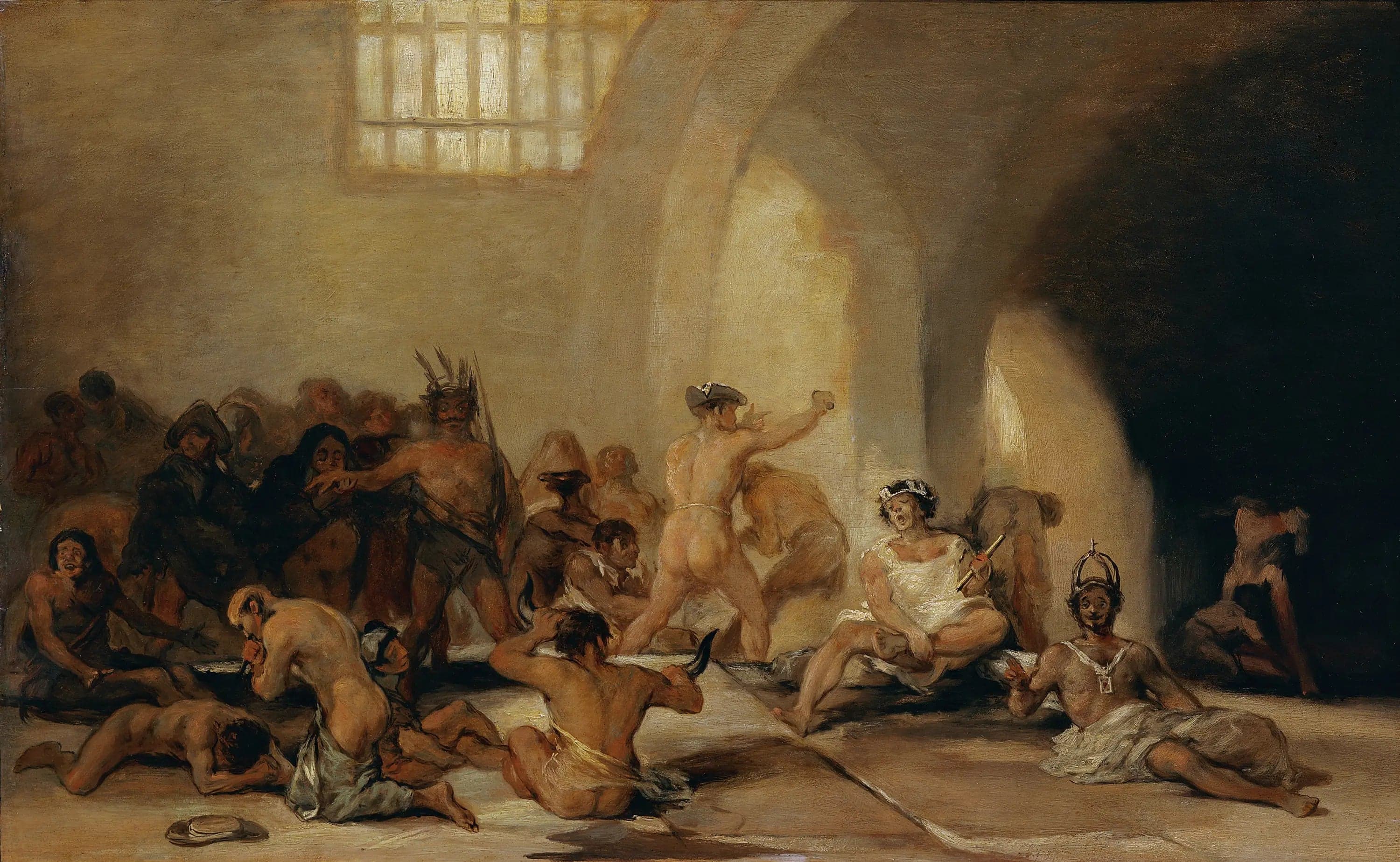
The House of Fools
- Original dimensions
- 69.5 x 44.5 cm
- Museum
- Österreichische Galerie Belvedere
- Year
- 1794
Scene depicted
This painting immerses us in the dark world of a psychiatric hospital, where characters with lost and trapped gazes evoke a poignant study of dehumanization. The figures, judiciously arranged, are essential for understanding profound human suffering while raising questions about the nature of madness and the human condition, subjects that occupy a central place in Goya's work.
Historical context
Created in 1794 in Madrid, the vibrant capital of Spain, The House of Fools is an emblematic work of the romantic movement, also playing a pioneering role in the emergence of realism . In this troubled and tumultuous period, Goya addresses dark and profound themes, illustrating the struggle of man against madness and anguish. Currently housed at the Österreichische Galerie Belvedere , this painting testifies to the invaluable legacy of Spanish art, and its dimensions, 69.5 x 44.5 cm, capture a moment of striking visual intensity.
Place in the artist's career
The House of Fools represents a turning point in Goya's career, marking his maturity period where he explores the themes of pain and darkness more intensely. Alongside other great works like The Third of May 1808 and Saturn Devouring One of His Sons, this painting illustrates his artistic evolution, both technically and on a deeply emotional level, signifying a crucial step towards his unique and personal style.
Anecdote
“I paint what I see and what I feel,” Goya is said to have declared when inspired to create this masterpiece . Imagine a misty morning in an alley in Madrid, where the whispers of the mad and the cries of anguish intertwine with the distant ringing of bells. This atmosphere, laden with sadness and melancholy, fueled Goya's inspiration to create a painting that transcends the image and deeply touches the soul.