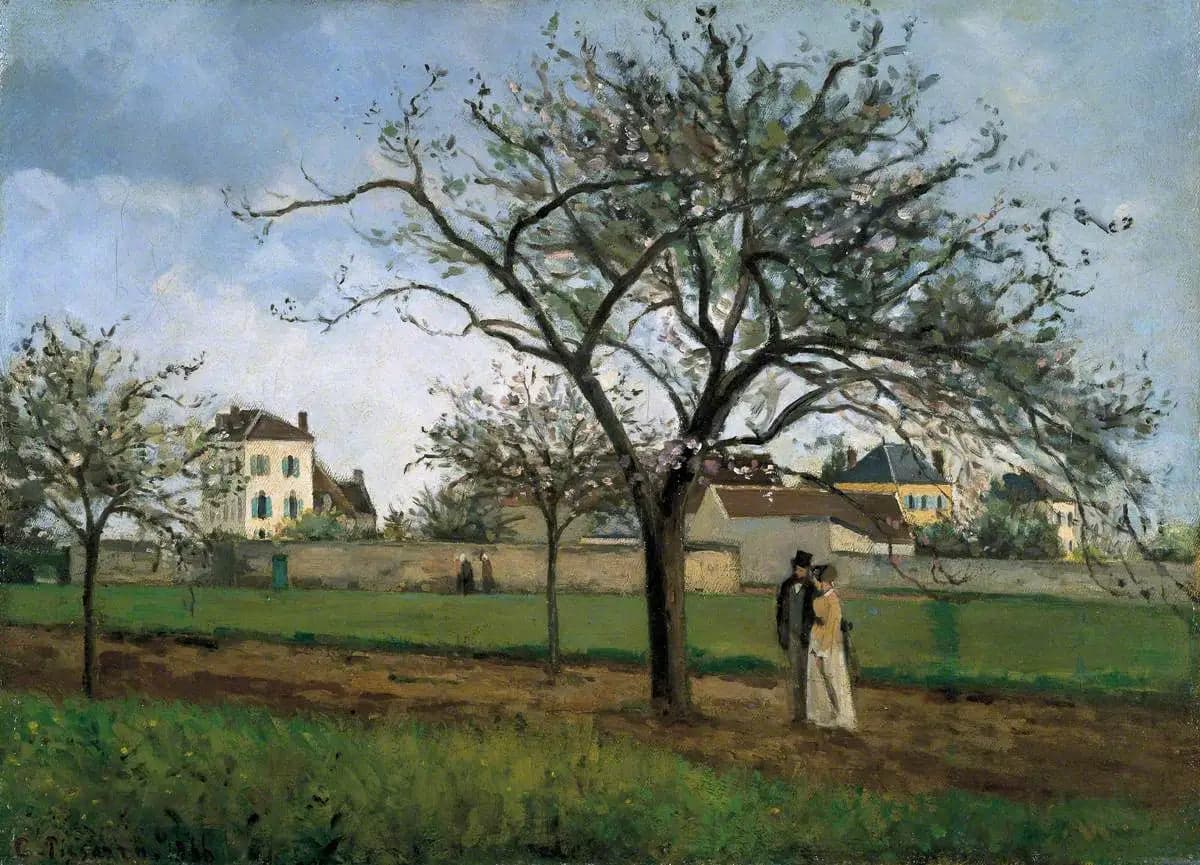
The House of Father Gallien, Pontoise
- Original dimensions
- 55.2 x 40.3 cm
- Museum
- Ipswich Museum
- Year
- 1866
Scene depicted
This painting transports us into a rural daily life where conviviality and serenity intertwine. In the foreground, the house of Father Gallien stands modestly, while the background reveals a harmonious landscape, bathed in the soft light of a summer day. This painting magnifies the unique interaction between man and his environment, offering a peaceful, almost contemplative vision of a moment frozen in time.
Historical context
Created in the heart of France in 1866, this painting is emblematic of a pivotal moment in art history, embodying the magic of the Impressionist movement. Located in Pontoise, a charming town in the Île-de-France region, this pictorial work was conceived at a time when free and innovative artistic expression was taking flight, born from the communion between nature and urbanity. Today, the canvas rests at the Ipswich Museum, watching over every admiring gaze that falls upon it.
Place in the artist's career
As one of the first major achievements of Camille Pissarro , The House of Father Gallien represents a crucial step in his artistic journey. This masterpiece is often paralleled with other iconic creations such as The Gardens at Éragny and On the Road to Pontoise , which testify to his growing technical evolution and his quest for light. Pissarro positions himself here as a pioneer whose work profoundly influenced the Impressionist movement.
Anecdote
“Nature is my muse, my eternal accomplice.” This quote perfectly illustrates Camille Pissarro 's passion for the environment that surrounded him. In painting The House of Father Gallien , Pissarro sought to capture the essence of a clear morning, when the first rays of sunlight brush the surface of the water, and the air is fragrant with spring flowers. It is in this atmosphere filled with promises that the painting came to life, imbued with the vibrant soul of living nature.