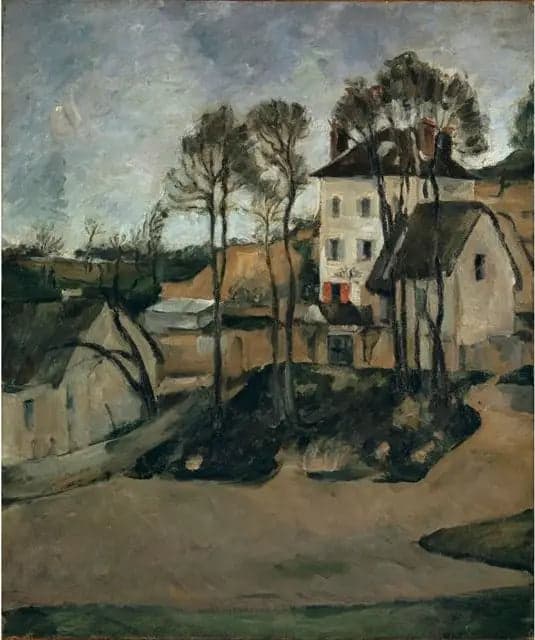
The House of Doctor Gachet in Auvers-sur-Oise
- Original dimensions
- 47 x 56 cm
- Museum
- Kunstmuseum Basel
- Year
- 1872
Scene depicted
This painting illustrates a bucolic view of the house of Dr. Gachet, a close friend of Vincent van Gogh. Auvers-sur-Oise, known for its natural beauty, unfolds under changing skies, where colors and shapes dance in harmony. Cézanne, with his unique gaze, composes a vibrant landscape, where each brushstroke evokes a story, an emotion, making this pictorial work a window into the soul of nature.
Historical context
Created in 1872 in Auvers-sur-Oise, this painting is at the heart of the Impressionist movement in full swing. It is here, in this charming town in the Île-de-France region, that the artist Paul Cézanne captured the very essence of his time. The canvas now rests at the Kunstmuseum Basel, serving as a testament to the artistic legacy of the late 19th century, with its dimensions of 47 x 56 cm inviting the viewer to a total immersion.
Place in the artist's career
The House of Doctor Gachet in Auvers-sur-Oise marks a significant milestone in Cézanne's career, illustrating his transition from pure Impressionism to a more personal exploration of structure and color. Alongside works such as "The Large Bathers" and "Mont Sainte-Victoire," this painting demonstrates his technical and emotional evolution towards a richer and more nuanced pictorial language.
Anecdote
“Nature is my only master, I want to serve it fervently,” Cézanne might have said as he composed this canvas inspired by the house of Dr. Gachet. Imagine him, one spring morning, strolling by the banks of the Oise River, observing the delicate play of shadows and light, a gentle breeze brushing his face, while a sweet floral scent floated in the air. This precious moment would have fueled his creative spirit, materializing in the evocative power of this masterpiece .