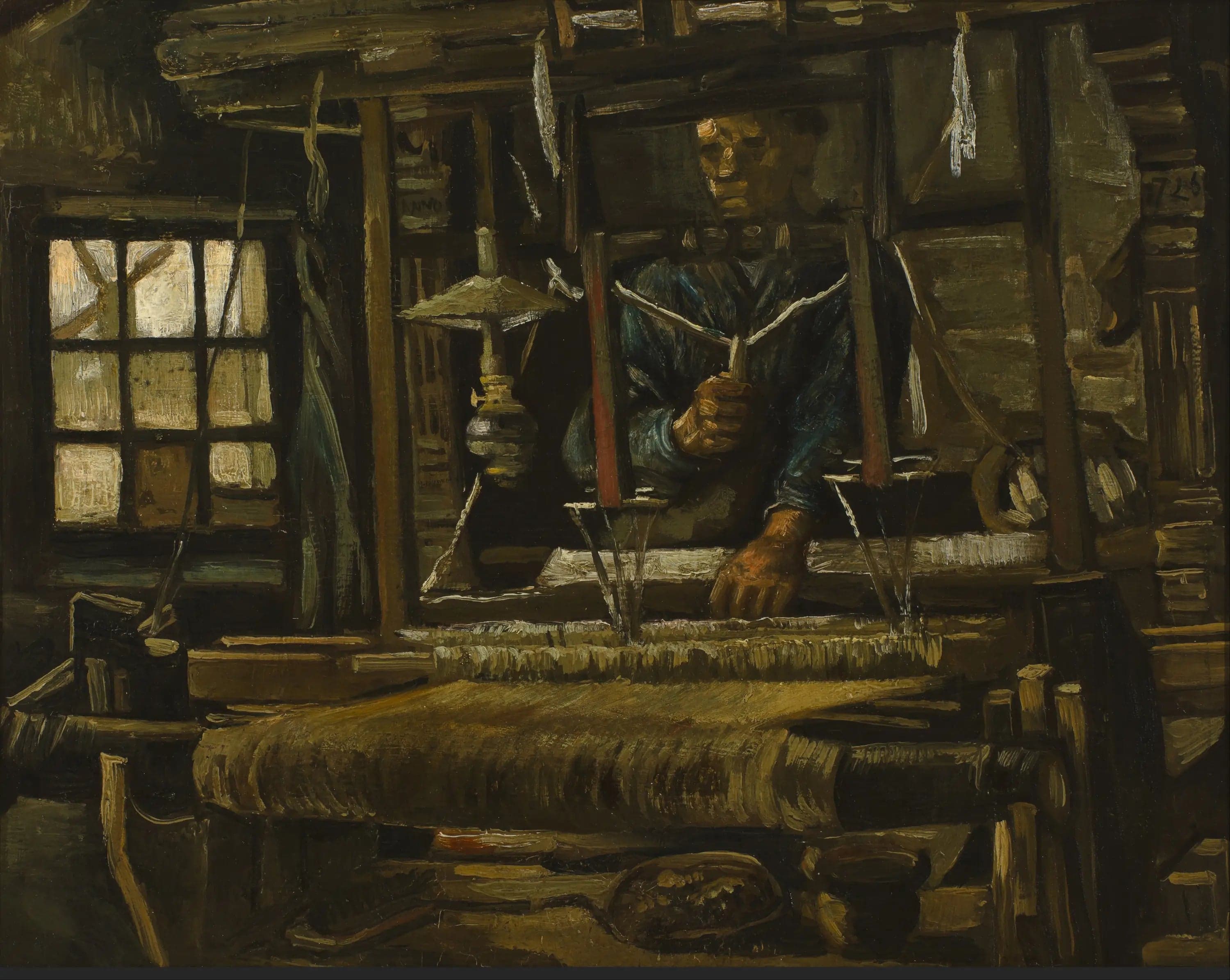
The House of a Weaver
Scene depicted
In this canvas , Van Gogh offers us an intimate view of the house of a craftsman. The composition immerses us in the humble and laborious world of a weaver, encapsulating both the worker and his environment. The painting evokes a pleasant harmony between man and his daily life, illustrating a moment suspended in time, rich in details and sensations.
Historical context
Created in 1884 in the peaceful town of Nuenen , this painting is part of the artistic movement of realism . At that time, Vincent van Gogh distinguished himself by his desire to capture everyday life and rural scenes, reflecting a world in motion. Currently, the canvas is carefully preserved at the Boijmans Van Beuningen Museum . Its dimensions of 61 x 47.5 cm evoke all the delicacy and intensity of this work.
Place in the artist's career
The Weaver's House represents a turning point in Van Gogh's artistic journey, where his mature style begins to take shape. It can be compared to other iconic pieces, such as The Potato Eaters and The Sower , which reveal deep color techniques and social observations, but here, the artist focuses on the delicacy of the subject.
Anecdote
Vincent van Gogh once stated: "Nature never deceives; its truths remain eternal." It is exactly this vision that inspired the moment he gazed upon the weaver's house, a morning bathed in light where the sweet song of birds mingled with the scent of freshly woven linen. This scene still resonates through the painting , exuding an atmosphere of peace and simplicity.