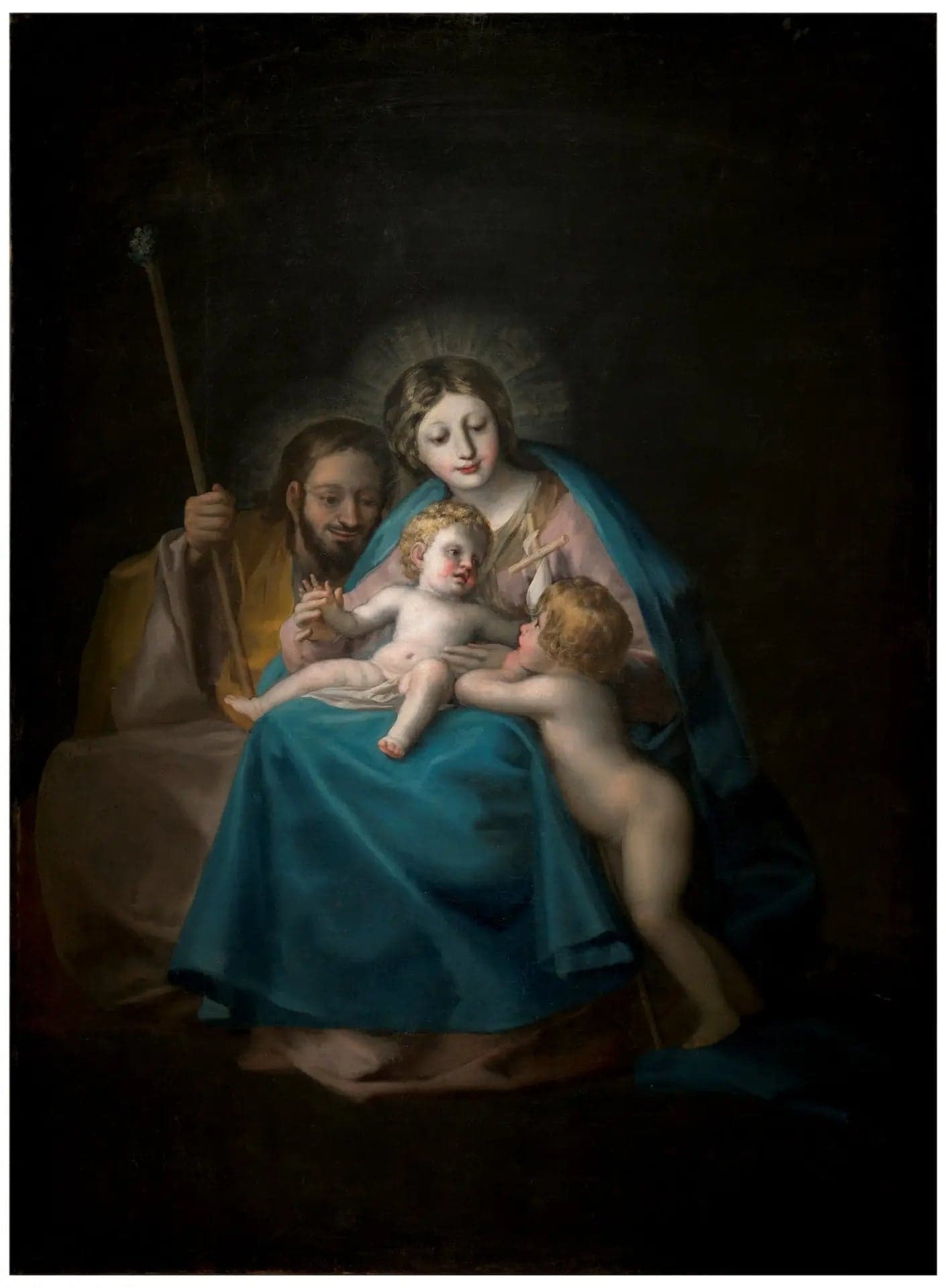
The Holy Family
- Original dimensions
- 51.5 x 63.5 cm
- Museum
- Prado Museum
- Year
- 1787
Scene depicted
In this canvas , Goya depicts a precious moment of familial intimacy. The Holy Family is represented in a harmonious composition, where soft light illuminates serene faces. Here, the solemnity and sweetness of the family intertwine, inviting the viewer to a moment of reflection on peace and unity. Through his style, Goya succeeds in merging spirituality and the everyday, making this work a true celebration of familial love.
Historical context
Created at the end of the 18th century in the enchanting city of Madrid, The Holy Family belongs to the neoclassicism movement. This painting, emblematic of its time, is set against a backdrop of profound artistic renewal where artists seek to reconnect with classical tradition while infusing their own sensitivity. Currently housed in the Prado Museum, this canvas of 51.5 x 63.5 cm is a powerful testament to Goya's expertise and his ability to capture familial intimacy.
Place in the artist's career
The Holy Family marks a turning point in Goya's career, projecting the power of his emotions while showcasing his technical mastery. It stands at the crossroads of two periods: his early works, marked by Spanish folklore, and his later, darker compositions, such as The Executions of May 3rd and The Clothed Maja , which denote an evolution towards greater psychological depth. This duality highlights the progression of his art, making each painting a crucial milestone in his journey.
Anecdote
“Light is the language of souls,” Goya said. His inspiration for this masterpiece was born one spring morning when he witnessed a tender glance between a mother and her child, a scene of daily life in Madrid. This fleeting encounter infused the painting with warmth, tenderness, and sincerity, allowing The Holy Family to evoke universal emotions through the ages.