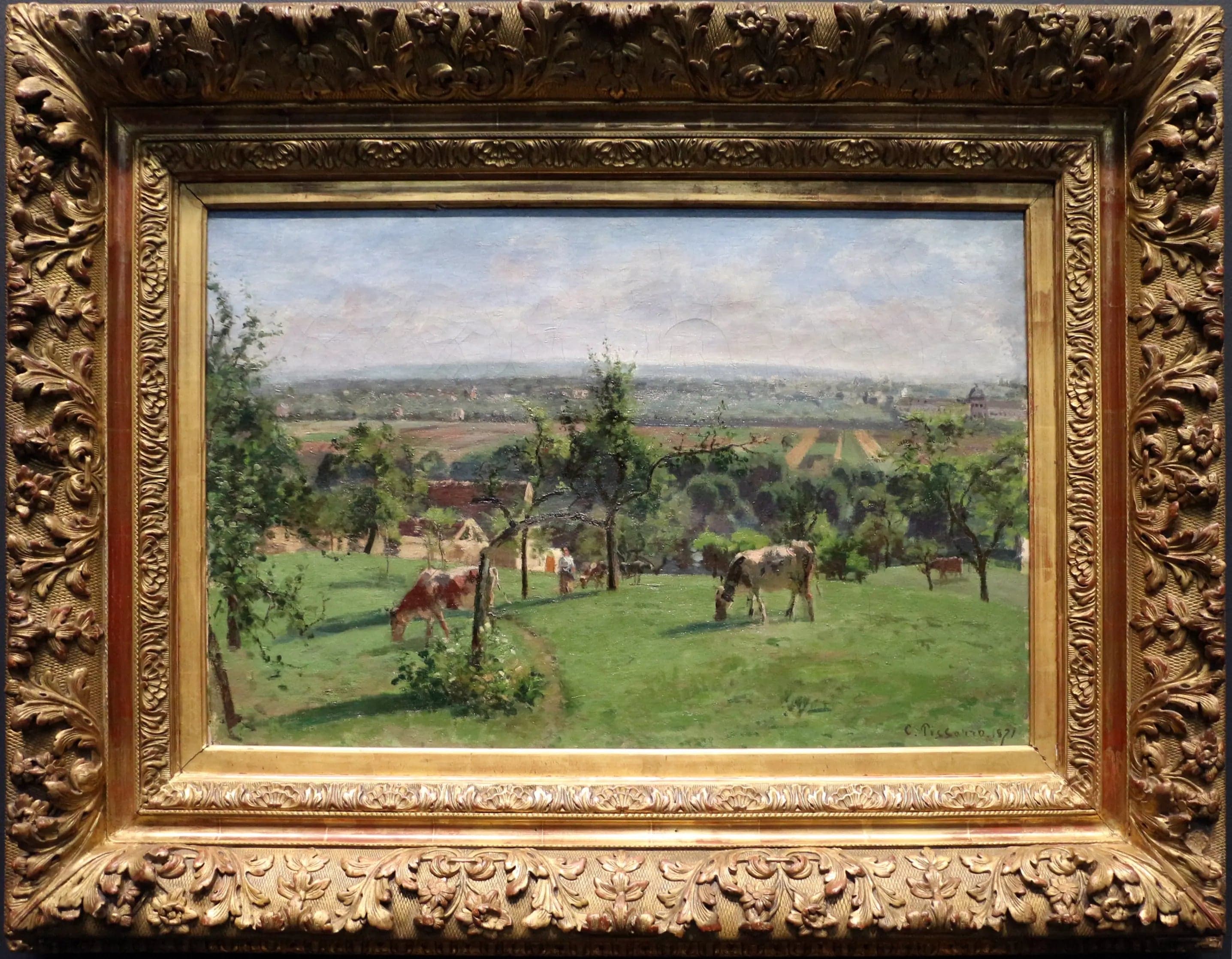
The Hills of Vésinet
- Original dimensions
- 65.5 x 43.5 cm
- Museum
- Orsay Museum
- Year
- 1871
Scene depicted
“The Hills of Vésinet” captures with unforgettable delicacy the picture of a landscape where the gaze gets lost between the verdant valleys and the dancing lights of dawn. The wonderful composition of this painting highlights the perfect symbiosis between man and nature, elevating the canvas to a true hymn to the simple beauty of existence.
Historical context
Created in the heart of Vésinet, a charming commune in Yvelines, in 1871, this painting is part of the Impressionist movement. The painting, now housed at the Orsay Museum in Paris, immerses us in the atmosphere of a time when nature is at the heart of the pictorial work. The dimensions of this canvas testify to a vibrant romanticism, meeting the beautiful and the natural.
Place in the artist's career
This painting is situated in a pivotal period of Pissarro's career, where he increasingly explores light and its effects. Alongside “The Potato Harvest” and “Boulevard Montmartre, Spring,” “The Hills of Vésinet” illustrates his technical evolution, marking a maturation of his Impressionist style while maintaining a unique sensitivity.
Anecdote
“Painting landscapes that sing life is my only happiness,” said Camille Pissarro . This quote resonates particularly during the exploration of his masterpiece , where one can almost hear the echoes of a peaceful spring morning, cradled by the whisper of leaves and the sweet scent of flowers, a scene of which the painting is the faithful echo.