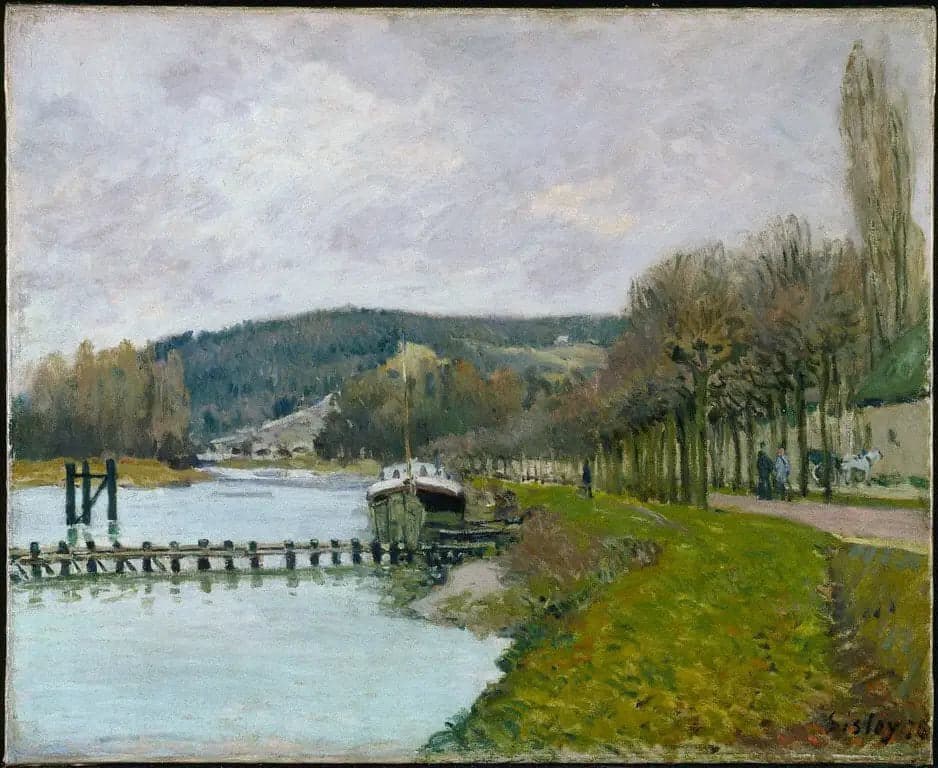
The Hills of Bougival
- Original dimensions
- 59.7 x 50.2 cm
- Museum
- National Gallery of Canada
- Year
- 1875
Scene depicted
This painting delicately illustrates the charming landscape of Bougival. The lush hills, dotted with picturesque houses, rise gently, while the Seine meanders peacefully below. The touches of color and the diaphanous light create an almost magical atmosphere, transporting the viewer into a moment suspended between dream and reality.
Historical context
Created in 1875, the painting “The Hills of Bougival” captures the very essence of the peaceful commune of Bougival, located on the banks of the Seine, west of Paris. Sisley, an iconic figure of Impressionism , immerses us in a world where light dances on the rooftops of houses. This painting, currently housed in the National Gallery of Canada , echoes a time when the rural landscape evoked both serenity and nostalgia, inviting contemplation.
Place in the artist's career
“The Hills of Bougival” is part of the full stylistic maturity of Alfred Sisley , at a time when he developed his distinct visual language. This canvas stands out alongside works such as “Saint-Martin-du-Vivier” and “The Seine at Argenteuil,” reflecting his technical evolution. Sisley, through his landscapes, seeks to capture the fleeting moment of nature in full metamorphosis.
Anecdote
“Light is a song, and each landscape a melody.” Thus spoke Sisley, recalling a spring morning when, visibly inspired, he sat down to immortalize the beauty of the hills. The gentle breeze, tinged with the floral scents of the surrounding bushes, nourished his imagination, bringing to life a masterpiece vibrant with emotions.