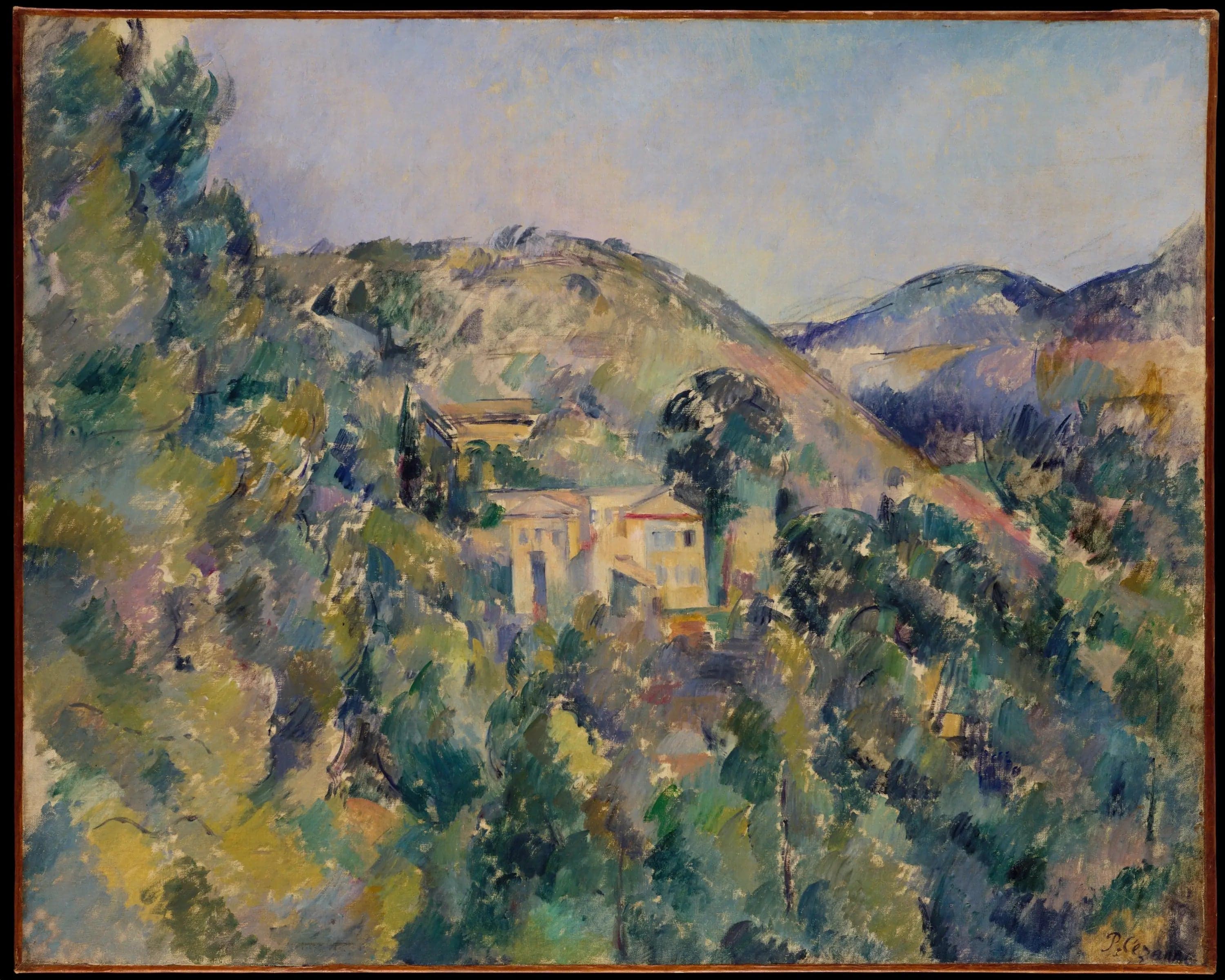
The Hill of the Poor near the Black Castle, with a view of Saint-Joseph
- Original dimensions
- 81.3 x 65.1 cm
- Museum
- Metropolitan Museum of Art
- Year
- 1880
Scene depicted
In this masterpiece, Cézanne invites us to contemplate a striking panorama, where nature and humanity meet. The scene depicts a peaceful hill overlooking the famous Black Castle, dominating the village of Saint-Joseph. Each brushstroke, rich and textured, tells a story of calm and contemplation, evoking both the tumult of human life and the serenity of the Provençal landscapes.
Historical context
Created in 1880, this painting is an emblematic reflection of an enchanting Provence, rooted in the post-impressionist artistic movement. The canvas, born in the beautiful region of Aix-en-Provence, bears witness to Cézanne's promising beginnings, whose work still resonates through the centuries. Currently exhibited at the prestigious Metropolitan Museum of Art , this canvas fascinates with its impressive dimensions and palpable depth, capturing the very essence of its time.
Place in the artist's career
This painting sits at a turning point in Cézanne's career, balancing between impressionism and the beginnings of cubism . Alongside works like "Mont Sainte-Victoire" and "The Large Bathers," this canvas testifies to his stylistic evolution. Cézanne pushes the boundaries of representation, transforming each canvas into a universe of perspectives and emotions.
Anecdote
As Cézanne said: "I want to make painting that helps to understand the world," thus illustrating the tireless quest for truth through his art. Imagine him, that morning, on the hill, a sweet scent of wildflowers perfuming the air, while the light danced on the lush landscapes, shaping his inspiration for this masterpiece that transports the observer by offering a vibrant vision of nature.