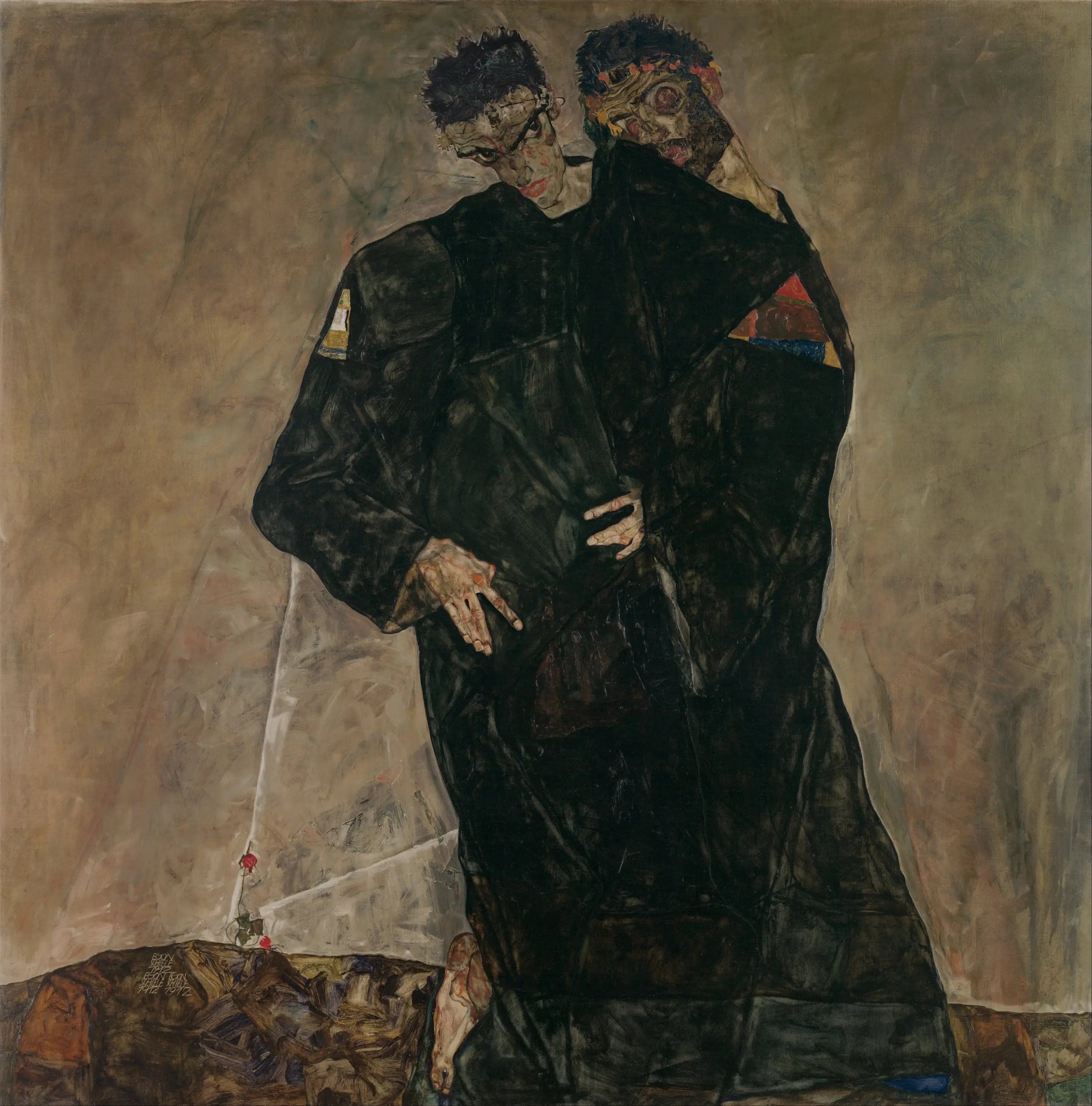
The Hermits
- Original dimensions
- 1810 x 1810 cm
- Museum
- Leopold Museum
- Year
- 1912
Scene depicted
This canvas illustrates two human figures, emblems of the quest for solitude and authenticity, standing apart from society. The bodies are drawn with a harsh vigor, reflecting the burning desire to seek one's essence, while the surrounding landscape testifies to a nature that is both wild and comforting. Each element of the composition reveals the dichotomy between isolation and harmony, an invitation to explore the deepest human emotions.
Historical context
Created in 1912, this painting draws its source from the vibrant setting of Vienna, at a time when expressionism flourished as a bold artistic movement. The canvas , now preserved at the Leopold Museum , immerses us in a universe where the human soul is both the object of study and the key to emotional introspection. Its imposing dimensions of 1810 x 1810 cm capture attention, inviting the viewer to fully integrate the work into their environment.
Place in the artist's career
The Hermits positions itself as a significant work at the heart of Egon Schiele 's career, marking a stage where his style asserts and refines itself. At this time, he bursts with creativity, as evidenced by his paintings such as “Self-Portrait with Plaid” and “Death and the Maiden.” These works reveal a marked evolution, transitioning from raw expression to an emotional and stylistic sophistication that will make him a master of expressionism.
Anecdote
“I seek to depict the invisible,” Schiele might have said one sunny morning. Inspired by a journey through mystical forests, he would have seen in the shadows of the trees a reflection of his own inner path. This fleeting moment of discovery resonates intensely through the expressive force of The Hermits, infusing this painting with a palpable depth of emotions.