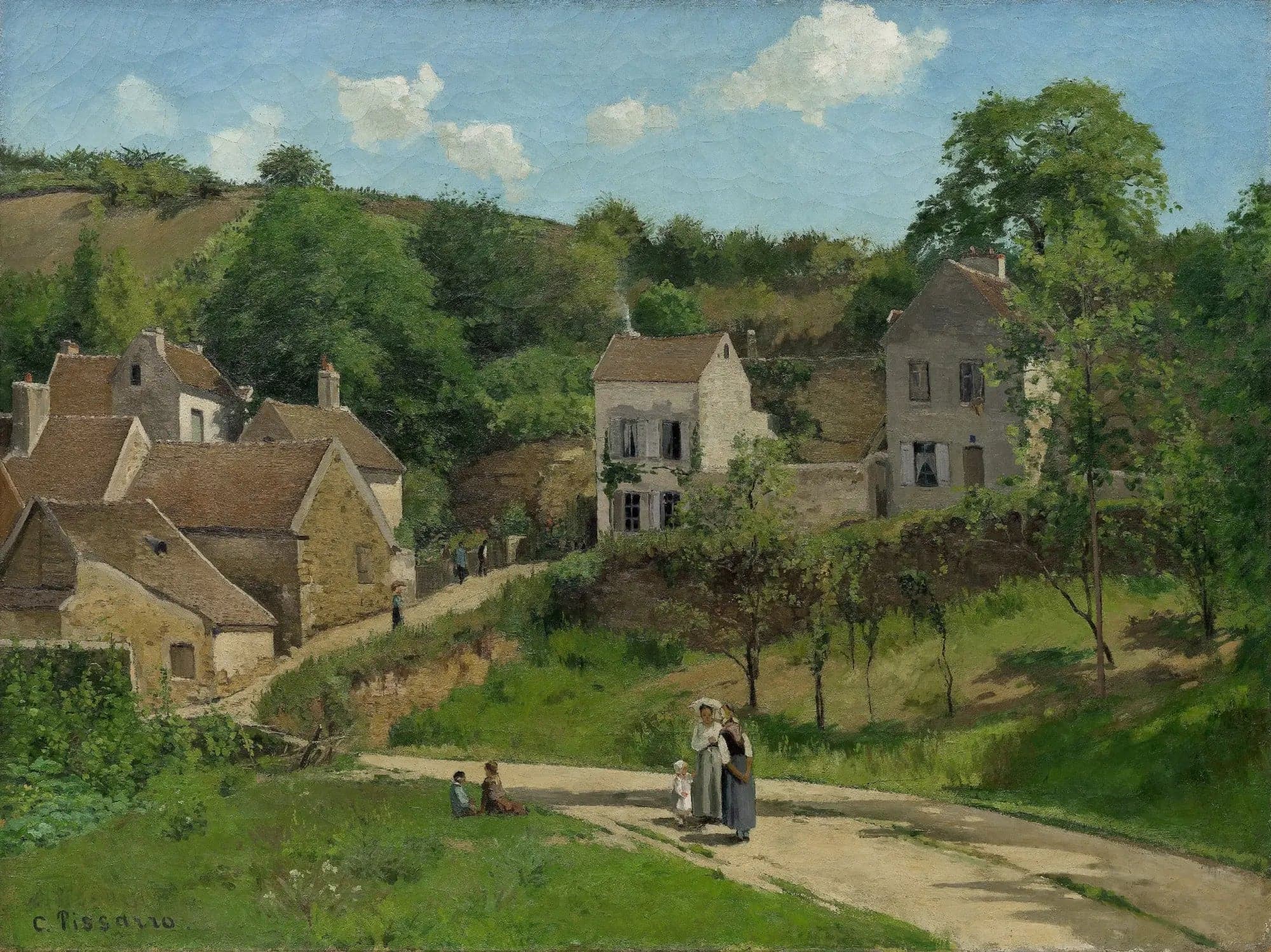
The Hermitage at Pontoise, The Hills of the Hermitage, Pontoise
- Original dimensions
- 200.6 x 151.4 cm
- Museum
- Solomon R. Guggenheim Museum
- Year
- 1867
Scene depicted
This painting evokes a panoramic view of the hills of L'Hermitage, where the tranquility of the landscape calms the soul and invites daydreaming. Pissarro succeeds in transporting the viewer into a vibrant reality, equipped with a play of light and shadows, ladies of nature mingling in a delicate dance under the azure sky.
Historical context
Created in 1867, the painting celebrates the lush hills of Pontoise, a charming town in the Île-de-France region, the cradle of the Impressionist movement. This canvas , currently exhibited at the Solomon R. Guggenheim Museum, embodies the beginnings of a revolutionary artistic era, where light and color intertwine in a new artistic vocality.
Place in the artist's career
L'Hermitage in Pontoise represents a turning point in Pissarro's career, positioning itself between his emergence as an innovative painter and the culmination of his Impressionist style. Echoing his other canvases like “Le Boulevard Montmartre, Spring” and “Les Jardins de l'Inn” from 1886, this work reveals his technical and emotional evolution, marked by a deep understanding of light and color.
Anecdote
“Nature is my best teacher,” said Camille Pissarro . In spring, as a gentle breeze caresses the leaves, he is inspired by the bright landscapes of L'Hermitage. It is in this suspended moment that he captures the very essence of the canvas , a pictorial work where each brushstroke vibrates to the rhythm of the life surrounding it.