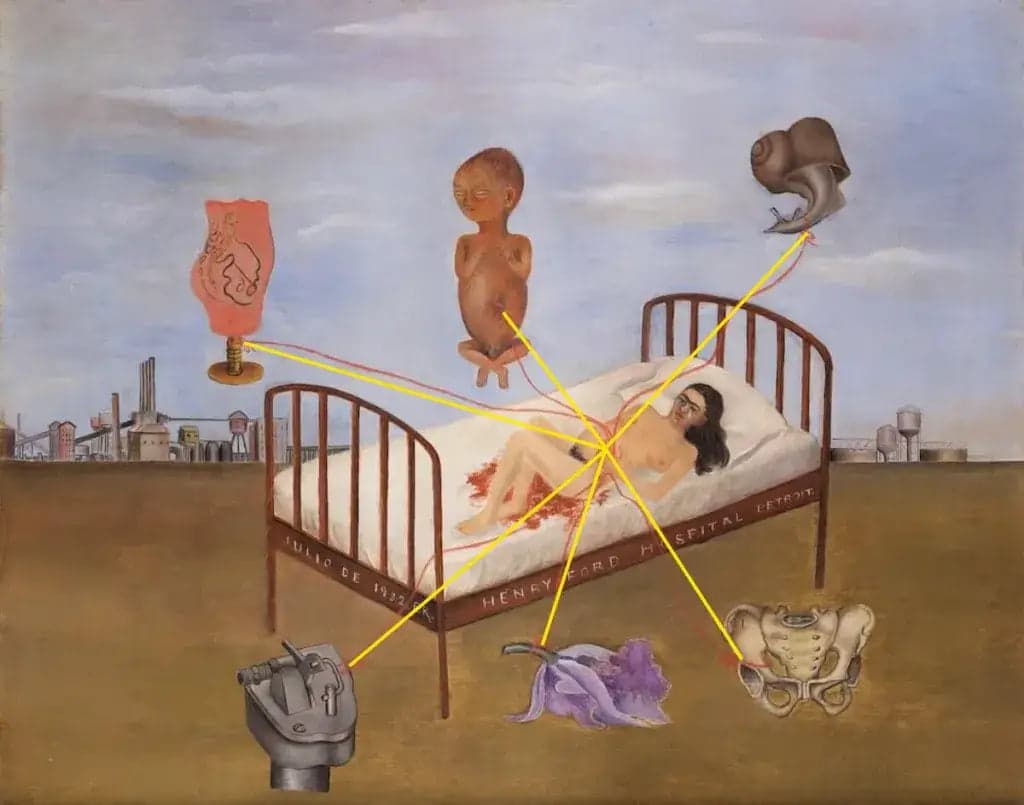
The Henry Ford Hospital
- Original dimensions
- 38 x 30.5 cm
- Museum
- Dolores-Olmedo Museum
- Year
- 1932
Scene depicted
In "The Henry Ford Hospital," Frida Kahlo depicts a scene filled with emotions, illustrating the era of medical care in an American hospital. This painting evokes the suffering of a generation affected by inner and social battles. The elements present tell not only a personal story of struggle but also a call for collective resistance, making this work even more incredibly poignant.
Historical context
Created in 1932, in Mexico, the painting "The Henry Ford Hospital" is part of the artistic movement of realism . Frida Kahlo , an iconic artist, painted this work during a time of personal and political upheaval that deeply influenced her style and aesthetic choices. The painting is now housed in the Dolores-Olmedo Museum, a cultural gem that preserves the memory of this pictorial work. Its dimensions of 38 x 30.5 cm add a certain intimacy, a closeness to the viewer.
Place in the artist's career
This painting , from a period of great questioning, represents a turning point in the career of Frida Kahlo . The evocative power of "The Henry Ford Hospital" is also illustrated by her previous creations such as "The Broken Column" and "The Two Fridas," exploring themes of duality and suffering, while reflecting a stylistic evolution marked by vibrant colors and raw emotions.
Anecdote
"I paint flowers so they do not die," said Frida. This phrase resonates powerfully when contemplating her masterpiece . Imagine a bright morning in Mexico, the scents of bougainvilleas floating in the air and the light of a shining sun illuminating the walls of the hospital, inspiring Frida to paint this painting imbued with deep hues and complex feelings.