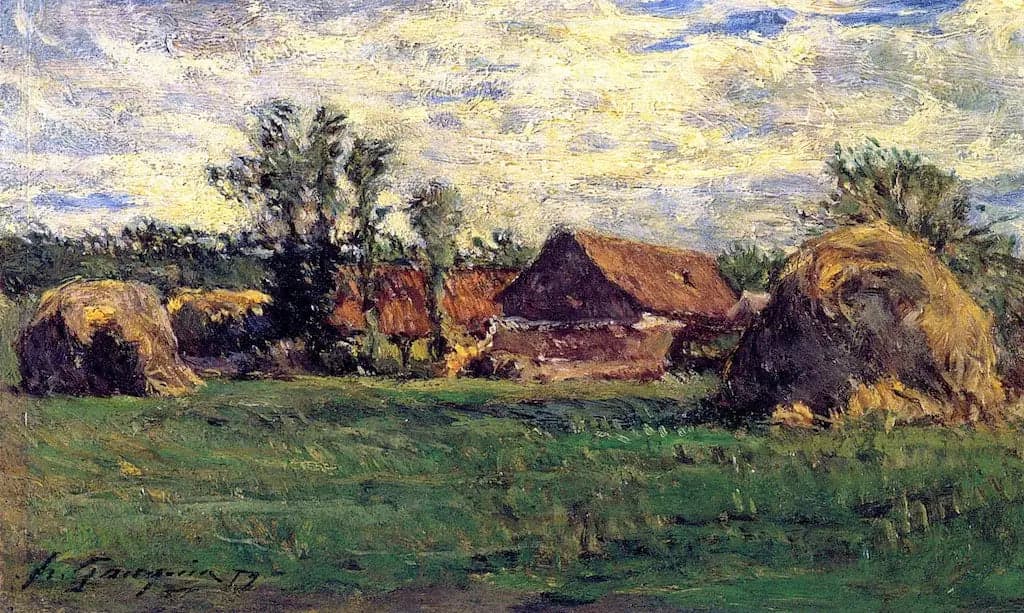
The Haystacks, or Surroundings of Pontoise
- Original dimensions
- 24 x 15 cm
- Museum
- Not specified
- Year
- 1879
Scene depicted
The painting “The Haystacks, or Surroundings of Pontoise” depicts a rustic scene, where haystacks accumulate, creating a striking contrast with the azure sky. This pictorial work evokes not only the hard labor of farmers but also the sacred bond that unites man to the earth. Every element of the landscape is imbued with light, highlighting the simple and serene beauty of rural life, a theme dear to Gauguin.
Historical context
Created in 1879, this painting is part of the Impressionist movement and evokes the bucolic setting of the surroundings of Pontoise, a French town located north of Paris. At that time, artists sought to capture the nuances of natural light and the beauty of the landscapes of the French countryside. Although the canvas , of modest size, has not yet been discovered in a specific museum, its essence is transposed through each brushstroke, testifying to a moment frozen in time.
Place in the artist's career
“The Haystacks, or Surroundings of Pontoise” represents a formative period in Gauguin's career, an artist seeking to establish his identity within the Impressionist movement. This canvas can be put in perspective with “Vision after the Sermon” and “The YELLOW Christ,” where one sees an evolution towards a more symbolic and colorful expression, marking his transition to Post-Impressionism .
Anecdote
“The soul of the landscape reveals itself to lovers of nature,” said Gauguin. On a gentle spring morning, as a light mist caresses the golden wheat fields, the artist finds inspiration in the soft light, the whisper of the wind, and the scent of freshly plowed earth surrounding the haystacks. In every detail of this painting , one can feel his passion and deep attachment to nature, which becomes the heart of his composition .