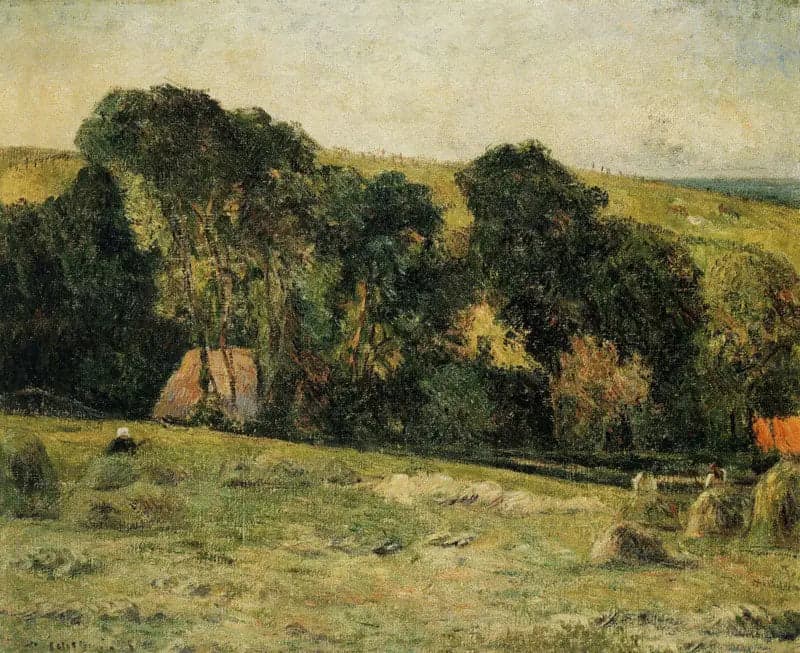
The Haymaking near Dieppe
- Original dimensions
- 73 x 59 cm
- Museum
- National Museum of Fine Arts in Algiers
- Year
- 1885
Scene depicted
This pictorial work immortalizes the beauty of a summer, capturing workers in a moment of serenity. The painting depicts a hayfield, where the light caresses the golden stalks, paying tribute to the harmony between man and the earth. The characters, although stylized, seem to infuse eternal life into human activity, a tribute to nature and its rhythm.
Historical context
This painting , created in 1885, finds its roots in Dieppe, an iconic town in the Normandy region, at the heart of a time when impressionism was beginning to gain followers. Paul Gauguin , one of the pioneers of symbolism , extended his quest for artistic authenticity here. Today, the painting is carefully preserved in the National Museum of Fine Arts in Algiers, a symbol of the pictorial innovation of the 19th century.
Place in the artist's career
The Haymaking near Dieppe occupies an essential place in Gauguin's artistic ascent. It is part of a period of stylistic exploration, evolving from works such as Visit to Christ and The Yellow Christ . These paintings testify to a growing maturity, as Gauguin frees himself from conventions to embrace a more personal and expressive vision.
Anecdote
“I paint things as I feel them, much more than I see them.” We can imagine Gauguin, that morning, contemplating the silhouettes of the harvesters, swayed by the gentle breath of the wind, a suspended moment that infuses his canvas with this living essence, an echo of that fleeting moment embodied in The Haymaking near Dieppe .