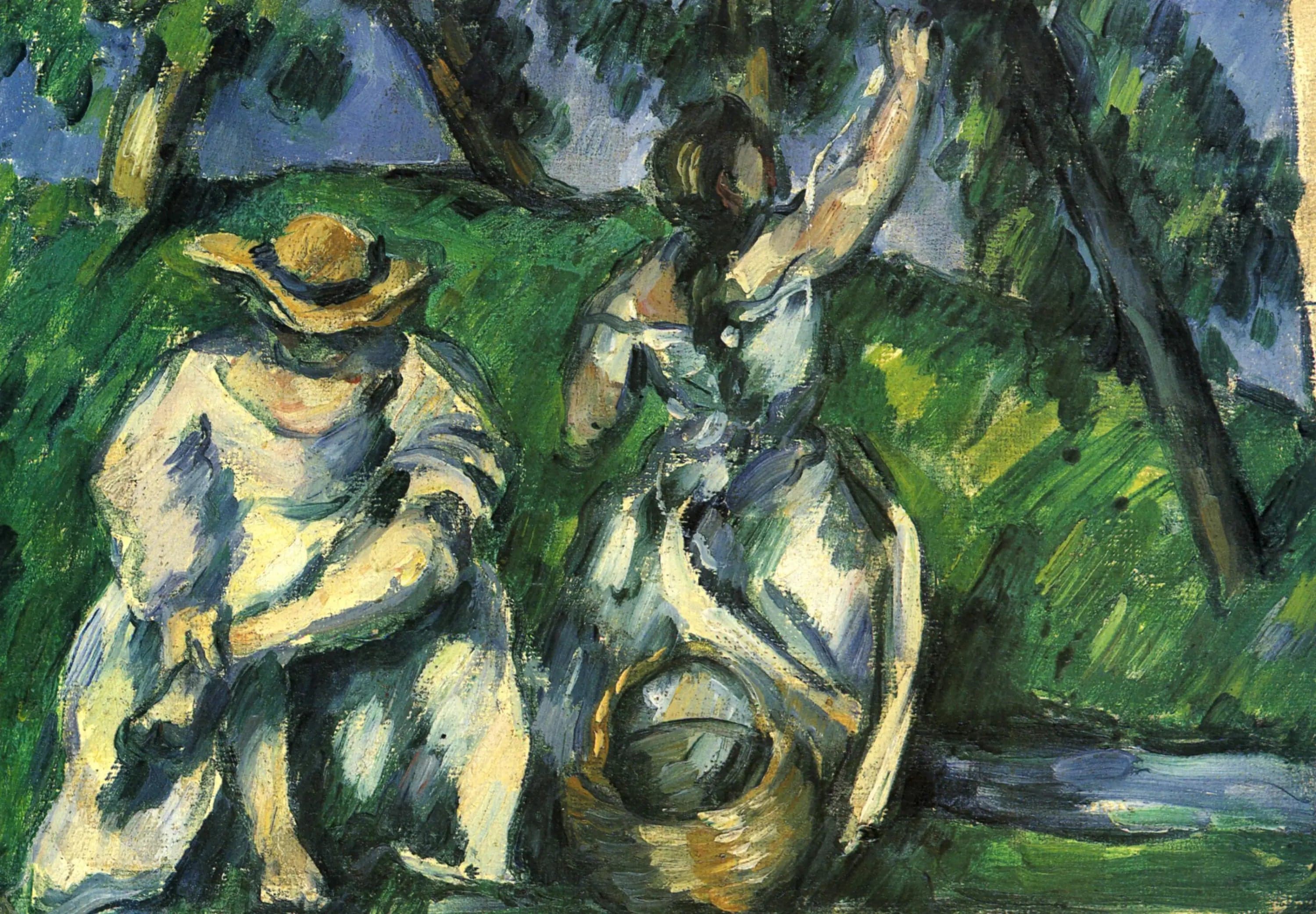
The Harvest
- Original dimensions
- 22.5 x 15.5 cm
- Museum
- New York
- Year
- 1876
Scene depicted
The painting “The Gathering” transports us to a bucolic scene, illustrating a perfect harmony between man and nature. A peaceful commotion emanates from this painting , where figures delicately lean over crops while majestic trees rise in the background. The play of light and rich textures expose a world where each element responds perfectly to one another.
Historical context
Created in 1876, this painting is emblematic of New York, at the heart of a revolutionary artistic movement, post-impressionism . At that time, Cézanne was redefining the principles of light and color, challenging traditional conventions and placing his canvas at the forefront of modern art. The canvas immerses the viewer in the vibrant atmosphere of spring, at the golden age of the French landscape.
Place in the artist's career
“The Gathering” marks a turning point in Cézanne's career, representing a maturation point in his artistic exploration. In parallel with his works such as “The Card Players” and “Mont Sainte-Victoire,” one observes an evolution towards bolder and more colorful compositions, where sensation and impression take precedence over faithful representation.
Anecdote
“Nature is my true master,” Cézanne might have said, inspired by the gardens and alleys of his native Provence. This canvas , capturing the essence of a moment of gathering, evokes a peaceful morning where the simple beauty of nature becomes an ode to life. Each brushstroke is a statement, a gentle breeze laden with the floral scents of the moment.