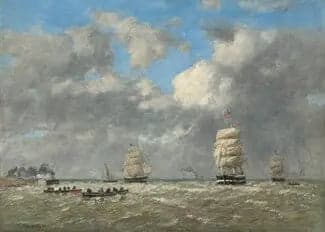
The Harbor
- Original dimensions
- 72.87 x 52.39 cm
- Museum
- National Gallery of Art
- Year
- 1883
Scene depicted
The painting "Le Havre" by Eugène Boudin evokes a vibrant scene of the Norman port, bathed in the changing lights of the morning sun. The boats, sometimes moored, sometimes sailing on the waves, create an uninterrupted dynamic. The sky, a deep blue, blends with the shades of the waters, drawing a living tableau where each brushstroke seems to whisper the incessant activity of this historic and maritime place.
Historical context
Created in 1883, the painting "Le Havre" is set in the geographical and historical framework of the beautiful port city of the same name, in Normandy. This canvas , belonging to the Impressionist movement, reflects a time when light and color are no longer mere elements, but potentially revolutionary tools of modern art. Today, this exceptional pictorial work is located at the National Gallery of Art , where it continues to amaze viewers and provoke sensitivities, measuring 72.87 x 52.39 cm.
Place in the artist's career
Positioned as a key milestone in the career of Eugène Boudin , "Le Havre" represents an expression of artistic maturity. Before this work , he had already sketched remarkable seascapes, such as "Le Sablon" and "La Plage de Trouville." These canvases , while equally captivating, reflect a less bold approach compared to this canvas , where his concern for light and the surrounding composition shines brightly.
Anecdote
“The sea, with its changing lights, is an eternal gift, offering the eye infinite compositions.” This quote from the artist resonates with the essence of the masterpiece that is "Le Havre." Imagine Eugène Boudin , on a spring morning, walking along the docks of the port, inspired by the flight of white sails and the gentle murmur of the waves. It is in this magnificent setting, where nature dances with urbanity, that he managed to capture the very soul of his subject.