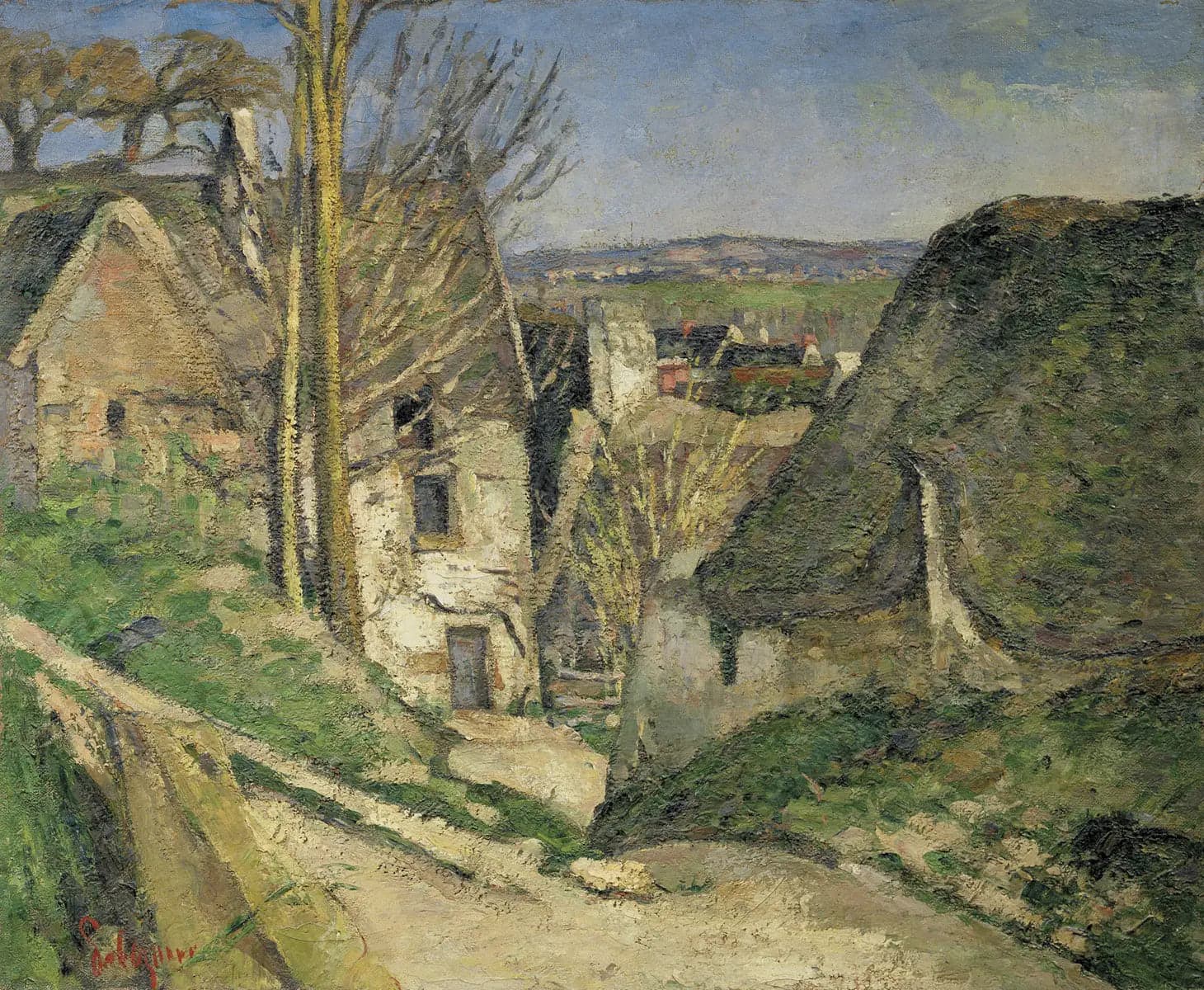
The Hanged Man's House
- Original dimensions
- 66.3 x 55.5 cm
- Museum
- Orsay Museum
- Year
- 1874
Scene depicted
The House of the Hanged Man stands majestically, surrounded by lush greenery and troubled skies. This painting tells a moment that is both serene and tragic, a reminder of the cycle of life through a soothing composition. Every detail, every color, evokes an almost palpable atmosphere, where one can feel the imprint of time and the weight of human existence.
Historical context
Created in 1874, this painting embodies the beauty of the landscapes of Auvers-sur-Oise, a charming town that inspired many artists of the Impressionist movement. At that time, Cézanne's innovative vision was just beginning, transforming the canvas into a window onto human emotion. Today, this precious painting resides at the Orsay Museum , reflecting the geometric and chromatic dimensions of its time.
Place in the artist's career
“The House of the Hanged Man” represents a key milestone in Cézanne's career, heralding his mature style and his ability to capture the very essence of nature. In parallel with other renowned canvases like “Mont Sainte-Victoire” and “The Large Bathers,” this painting showcases the evolution of his technique, palette, and his robust exploration of forms and light.
Anecdote
“The artist must feel nature before revealing it,” said Cézanne, while he was in a verdant alley of Auvers, cradled by the fresh song of birds and the gentle spring breeze. It was in this moment, surrounded by vibrant colors, that the inspiration for this masterpiece , “The House of the Hanged Man,” a painting full of life and depth, took root.
Major exhibitions
First Impressionist exhibition