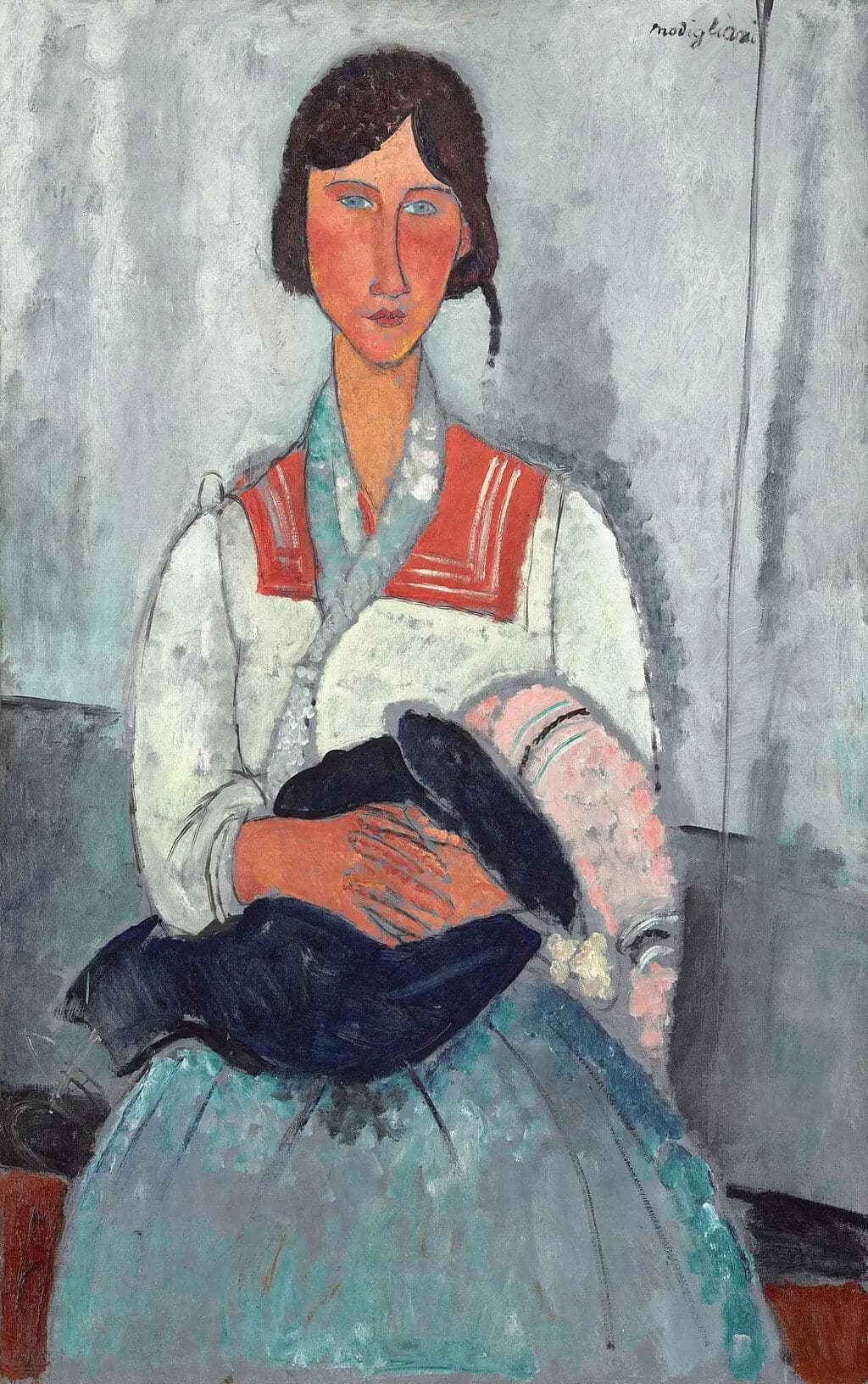
The Gypsy
- Original dimensions
- 73 x 115.9 cm
- Museum
- National Gallery of Art
- Year
- 1919
Scene depicted
This pictorial work depicts a woman of mysterious beauty in a contemplative pose. The elongated features and the gaze filled with melancholy are characteristic of Modigliani's unique style. Its representation is not limited to a simple illustration; it invites reflection on inner beauty and despair, filling the viewer with a gentle sadness.
Historical context
Created in 1919, this painting is located in the heart of Paris, an iconic city of modern art. The Bohemian is a unique work of the expressionist movement, reflecting a time when artists were redefining the principles of beauty. It is currently exhibited at the National Gallery of Art , where this canvas continues to fascinate visitors with its evocative power.
Place in the artist's career
The Bohemian represents the pinnacle of Modigliani's style, born from a period of artistic maturity. Compared to his other works like Reclining Nude and Head of a Woman, this canvas reveals a marked stylistic evolution, oscillating between a vibrant realism and subtle abstraction, solidifying his status among the masterpieces of the 20th century.
Anecdote
“I paint souls,” said Modigliani, referring to his desire to capture human essence. Imagine a spring morning in the heart of Montmartre, where the artist meets a muse with deep eyes. This fleeting moment inspires the canvas that is The Bohemian, its portrait imbued with powerful emotions.