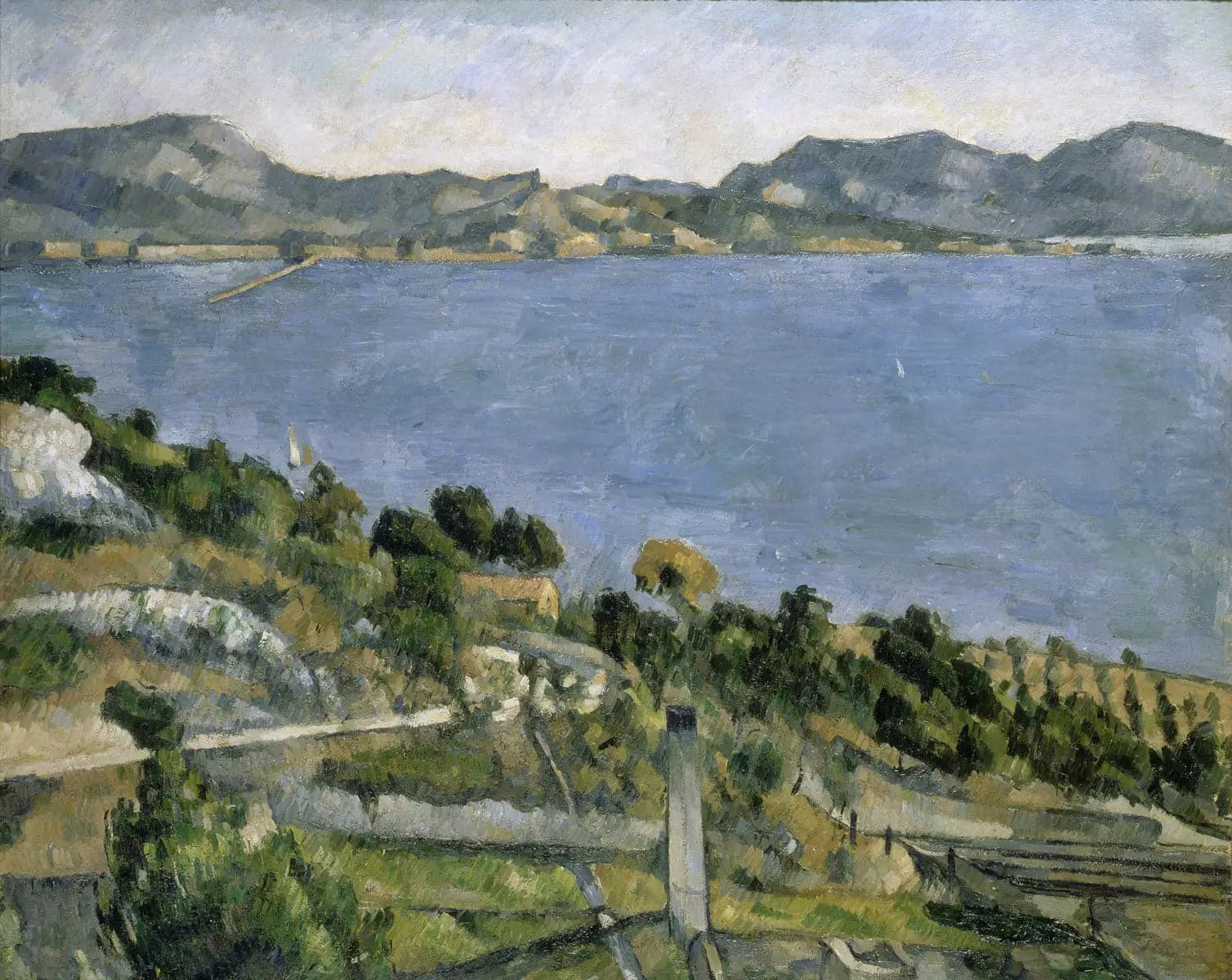
The Gulf of Marseille seen from L'Estaque
- Original dimensions
- 100.6 x 80.2 cm
- Museum
- Art Institute of Chicago
- Year
- 1885
Scene depicted
This painting captures the majesty of the Gulf of Marseille through an inimitable gaze. The shades of blue of the sea blend with the greens of the surrounding hills, creating a dialogue between the water and the sky. Each brushstroke tells a story, inviting the viewer to lose themselves in the depth of this painting .
Historical context
Created in 1885, this painting is emblematic of the picturesque setting of l'Estaque, a charming village on the Mediterranean coast. Paul Cézanne , a central figure of the post-impressionist movement, created this work during a period when he explored the nuances of light and color. Today, this canvas is carefully preserved at the Art Institute of Chicago , where it continues to inspire visitors.
Place in the artist's career
The Gulf of Marseille seen from l'Estaque represents a turning point in Cézanne's career, marking a transition to stylistic maturity. Alongside works such as Mont Sainte-Victoire and The Large Bathers, this canvas illustrates his evolution as a master of forms and colors.
Anecdote
“I want to paint the silence of things,” Cézanne reportedly said while contemplating the landscape before him. It was during a quiet morning, when the sunlight filtered through the hills, that the idea for this masterpiece came to him, forever anchoring wonder in this canvas .