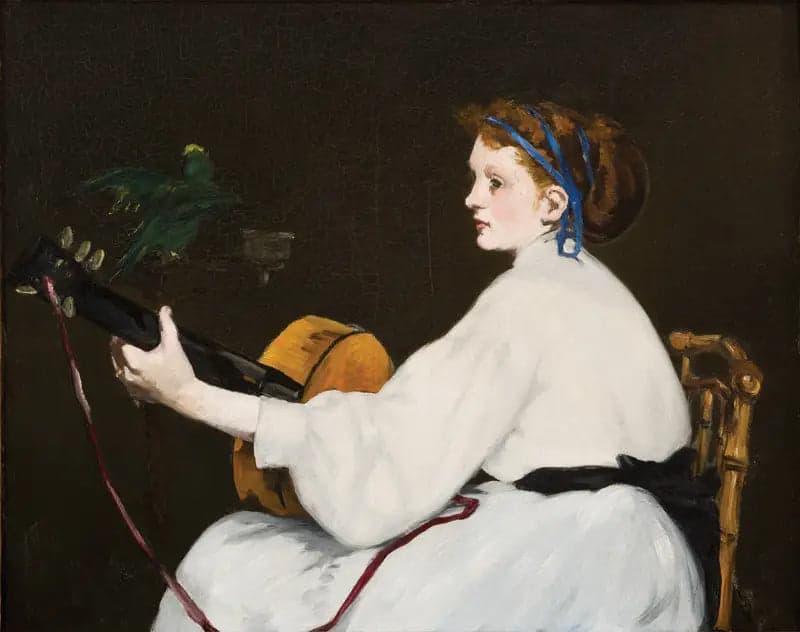
The Guitarist
- Original dimensions
- 80 x 63.5 cm
- Museum
- Hill-Stead Museum
- Year
- 1866
Scene depicted
In the painting “The Guitarist,” Manet immortalizes an intimate scene, a musician whose gestures convey an innate passion for music. His gaze, both focused and dreamy, plunges us directly into the vibrant world of art, where each note seems suspended in the air.
Historical context
Created in 1866, this canvas is a precious glimpse of Paris, all wrapped in the Impressionist movement that had not yet taken flight. The painting is now located at the Hill-Stead Museum , an art sanctuary set in Farmington, Connecticut. Contemplating this work, one feels the intensity of the 19th century, a period of social and artistic upheaval.
Place in the artist's career
This painting stands in Manet's trajectory as an essential milestone, between his promising beginnings in the 1860s and his mature brilliance of the following decade. Alongside “Olympia” and “Luncheon on the Grass,” it testifies to an evolution towards a bolder and more expressive style.
Anecdote
“Every note I hear speaks to me of freedom and life,” said Manet. This painting evokes his inspiration, captured in a beam of morning sunlight, shimmering through the streets of Paris. This fleeting moment, this face encountered in an alley, nourished the evocative power of this masterpiece.