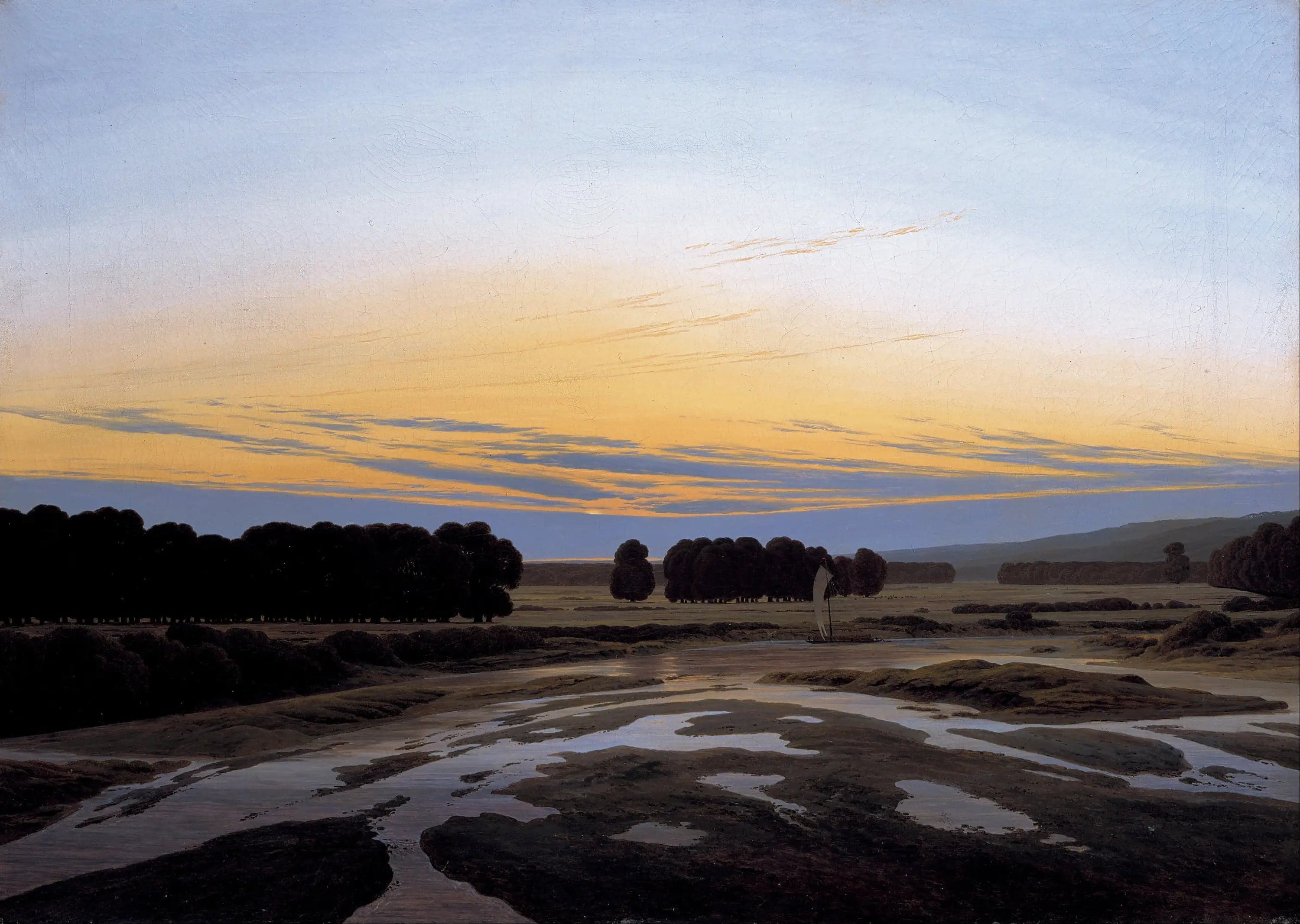
The Great Reserve
- Original dimensions
- 103 x 73.5 cm
- Museum
- Albertinum
- Year
- 1832
Scene depicted
In this pictorial work , Friedrich transports us to a landscape of hills covered with a verdant carpet, a haven of peace where nature reveals its raw and untainted beauty. The silhouettes of majestic trees rise in the foreground, while a cloudy sky seems to promise an atmosphere of mystery and contemplation. Each element of this painting dialogues to form a visual echo to the human soul, inviting reflection on its place in the grand picture of life.
Historical context
Created in 1832, in the German city of Dresden, The Great Reserve is at the heart of romanticism , an artistic movement governed by the exploration of emotions and sublime nature. This painting is carefully preserved in the Albertinum museum, where it continues to captivate the eyes of visitors with its spiritual depth and evocative atmosphere. With dimensions of 103 x 73.5 cm, this canvas is a window into a time rich in inspiration.
Place in the artist's career
The Great Reserve marks a turning point in Friedrich's career, as he stands at a crossroads between his bold beginnings and his artistic maturity. Alongside canvases like The Wanderer above the Sea of Fog and The Sea of Ice , this painting reflects a technical evolution where the body merges with the landscape, suggesting a deep communion between the artist and nature.
Anecdote
Caspar David Friedrich once declared: "Nature is my true master." It was during a morning walk through the light mist of an autumn morning that he found inspiration for The Great Reserve . This canvas, the result of a moment where wonder meets silence, evokes the magnificence of natural landscapes and the gentle melancholy that accompanies them.