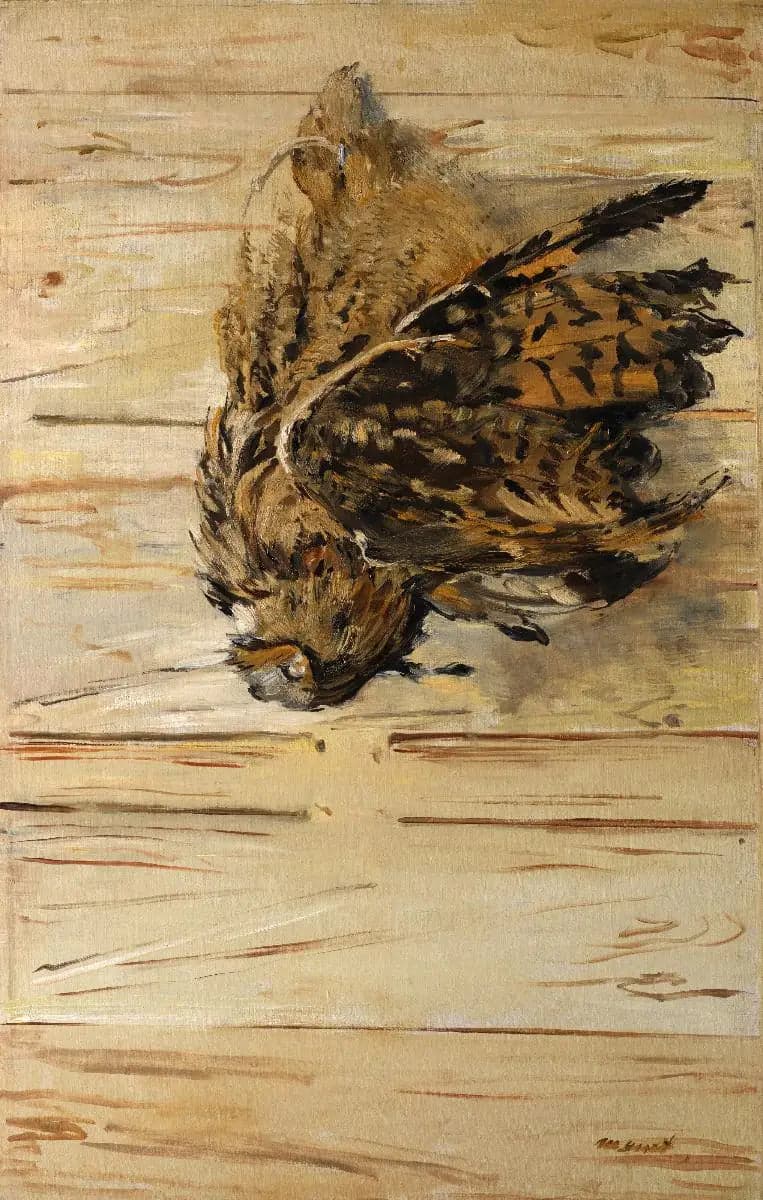
The Great Owl
- Original dimensions
- 64 x 97 cm
- Museum
- Emil G. Bührle Foundation and Collection
- Year
- 1881
Scene depicted
This iconic painting depicts a great horned owl, captivating both by its posture and the depth of its gaze. Manet manages to capture the essence of this unusual bird, placing it in a setting where light plays a fundamental role, thus energizing the entire composition. Each feather seems to vibrate under the weight of an intense and mysterious wild nature.
Historical context
Created in the heart of Paris at the end of the 19th century, The Great Horned Owl is part of an impressionist movement in full swing. Édouard Manet , an iconic figure of this era, forged a bold style that captured the light and mood of his subjects. Today, this painting is a centerpiece of the Emil G. Bührle Foundation and Collection , a cradle of art where the excellence of European pictorial heritage has crystallized.
Place in the artist's career
The Great Horned Owl represents a key period in Manet's career, illustrating his shift towards bolder themes and an even freer style. This painting is positioned between two other notable works: Le Déjeuner sur l'herbe and Olympia . It shows an increasing mastery of light and textures while continuing to challenge established conventions within pictorial art.
Anecdote
Manet once said: “Beauty is a fleeting moment.” One spring morning, while strolling through the bustling streets of Montmartre, he encountered a majestic owl. This fleeting encounter inspired the creation of this masterpiece , where the power of the bird's gaze invites deep reflection on nature and the fleeting beauty of art.
Major exhibitions
From Dürer to van Gogh - Bührle Collection meets Wallraf