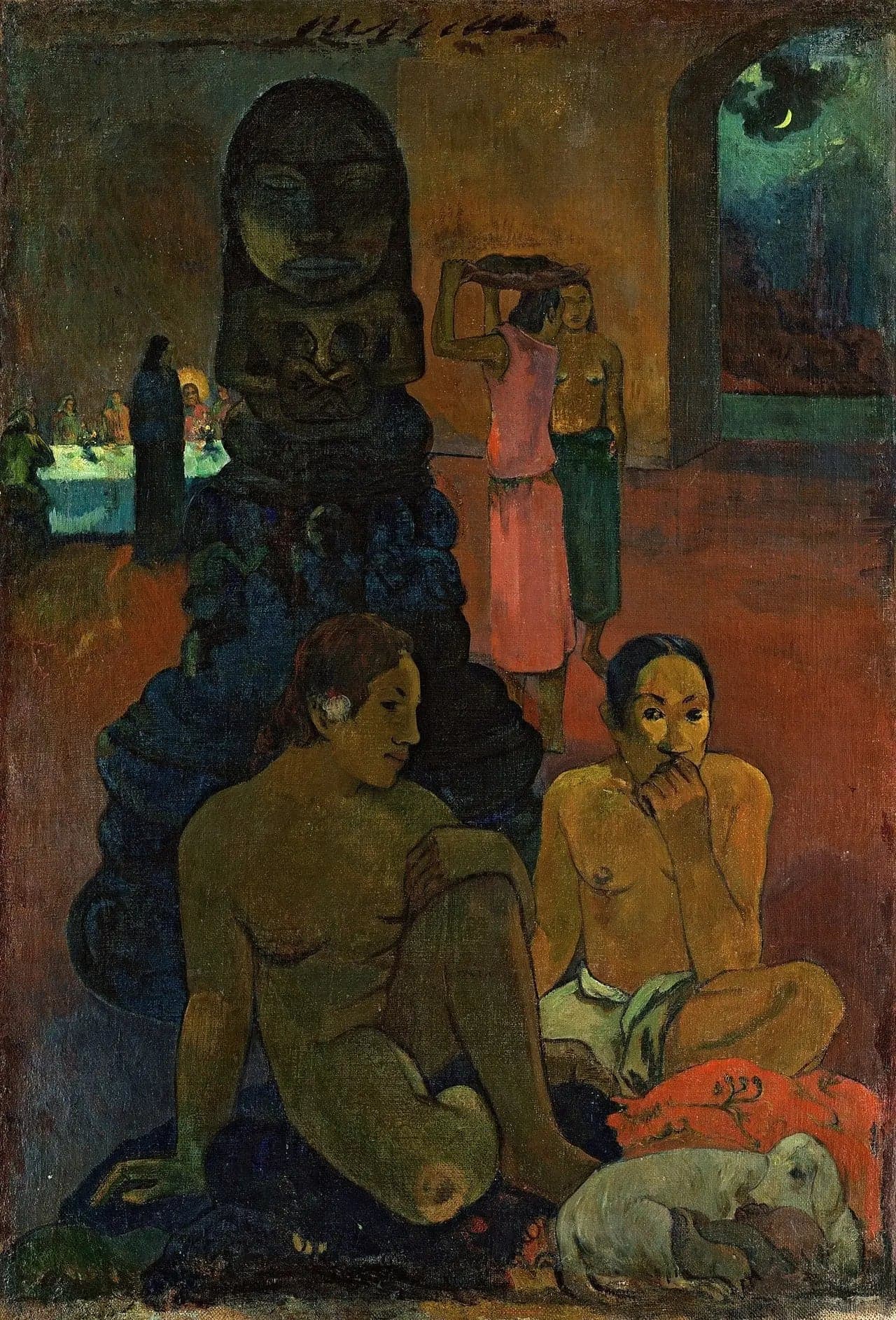
The Great Buddha
- Original dimensions
- 95 x 134 cm
- Museum
- Pushkin State Museum of Fine Arts
- Year
- 1899
Scene depicted
In “The Great Buddha,” Gauguin transports us to a universe where the figure of the Buddha majestically reigns. Filled with wisdom and calm, he evokes a deep tranquility, surrounded by lush nature, bathed in the vibrant light of the East. This painting reveals the artist's spiritual quest, an intimate connection between man and the infinite.
Historical context
Created in 1899, at the crossroads of a changing era, the painting “The Great Buddha” is part of the post-impressionist movement. Paul Gauguin , enriched by his travels in Polynesia, captured the essence of these sacred places. Currently exhibited at the Pushkin State Museum of Fine Arts in Moscow, this canvas of 95 x 134 cm transcends the boundaries of time and space.
Place in the artist's career
This masterpiece marks a turning point in Gauguin's career, illustrating his search for new forms of expression. When compared to “Vision after the Sermon” and “The Artist's Studio,” a marked stylistic evolution is evident, characterized by a bold use of color and simplified forms, reflecting his artistic maturity and his connection to the Polynesian world.
Anecdote
“Beauty is in simplicity,” said Gauguin, inspired by the serenity of a peaceful morning. As he observed the Great Buddha, his vision crystallized in this canvas , immortalizing a moment where the spiritual and the natural meet, giving the scene an unparalleled evocative power.