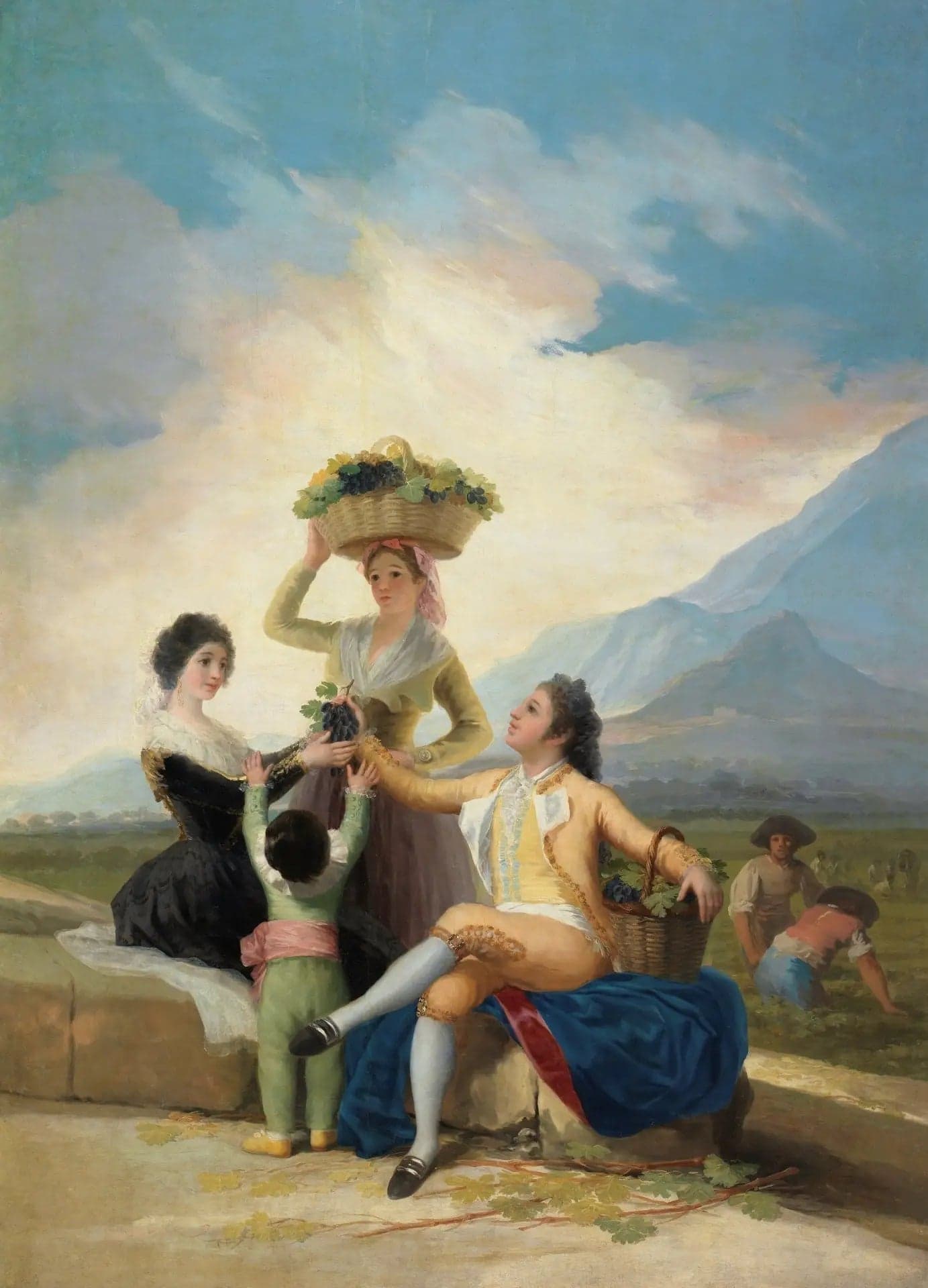
The Grape Harvest
- Original dimensions
- 190.5 x 267.5 cm
- Museum
- Prado Museum
- Year
- 1786
Scene depicted
In this captivating canvas, Goya depicts a group of peasants in the midst of grape harvesting, offering both a realistic and poetic vision of rural life. Their gestures, tender and laborious, illustrate a moment of communion with nature, reflecting the simple joys marked by the cycle of the seasons. Every detail of this painting tells a story, echoing within us the resonance of a bygone era.
Historical context
Created in 1786, this masterful work is set against the delicate historical context of Enlightenment Spain, where the artistic movement of romanticism is just beginning. Francisco de Goya , a successful painter, captured the essence of rural traditions and the deep emotions of his time. The painting is now housed in the Prado Museum in Madrid, a poignant testament to the richness of Spanish artistic heritage.
Place in the artist's career
Representing a significant period in Goya's career, this canvas is often regarded as a milestone between his phase as a precursor of romanticism and his darker approach to human nature in later works. Alongside masterpieces such as "The Third of May 1808" and "The Naked Maja," "The Grape Harvest" reveals a melancholic sweetness, a brighter and more festive facet of Goya's spirit.
Anecdote
“Beauty resides in the garden of nature, where truth and harmony blossom,” Goya is said to have declared. Inspired by the sweetness of a spring morning, he drew from a mundane yet vibrant scene of life to compose this masterpiece . The grape harvest, rituals of abundance and conviviality, resonates with the rhythm of this pure emotion that will transcend the centuries.