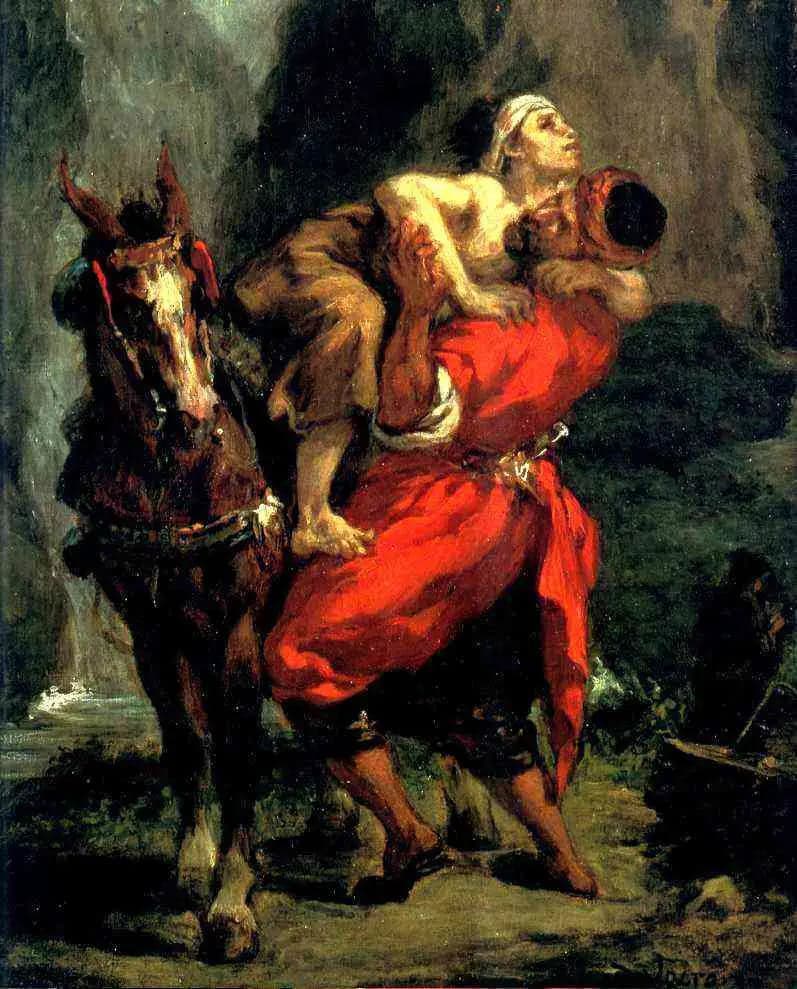
The Good Samaritan
- Original dimensions
- 30 x 37 cm
- Museum
- Not specified
- Year
- 1849
Scene depicted
This painting represents the essence of the biblical parable of the Good Samaritan, illustrating the act of kindness of a traveler who helps a wounded man by the roadside. The dramatic tension is palpable through the expressions and postures of the characters, revealing a touching narrative of courage and empathy. The painting invites the viewer to reflect on fundamental human values and the importance of reaching out to others.
Historical context
Created in 1849, the iconic canvas of The Good Samaritan emerged in a context where romanticism dominated the European artistic landscape. Eugène Delacroix , residing in Paris, was influenced by the sociopolitical upheavals of his time, aligning himself with a movement that sought to be the voice of emotions and sensitivity. This painting is currently in a private collection, adding to its mystery and allure. Its dimensions, 30 x 37 cm, give it an intimate yet striking presence.
Place in the artist's career
The Good Samaritan marks a pivotal period in Eugène Delacroix's career, solidifying his reputation as a master of romanticism. Alongside works such as Liberty Leading the People or The Massacre at Chios , this painting illustrates his ongoing exploration of themes of humanity, passion, and color, reflecting his evolution as an artist and his considerations in representing the human condition.
Anecdote
“In every exchanged glance, every sketched gesture, there lies a story worth telling.” This quote could resonate as a reminiscence of the genesis of this masterpiece . Delacroix, inspired on a sunny morning, would have observed a scene in the streets of Paris, a striking image that awakened in him the passion to render human compassion palpable in his canvas .