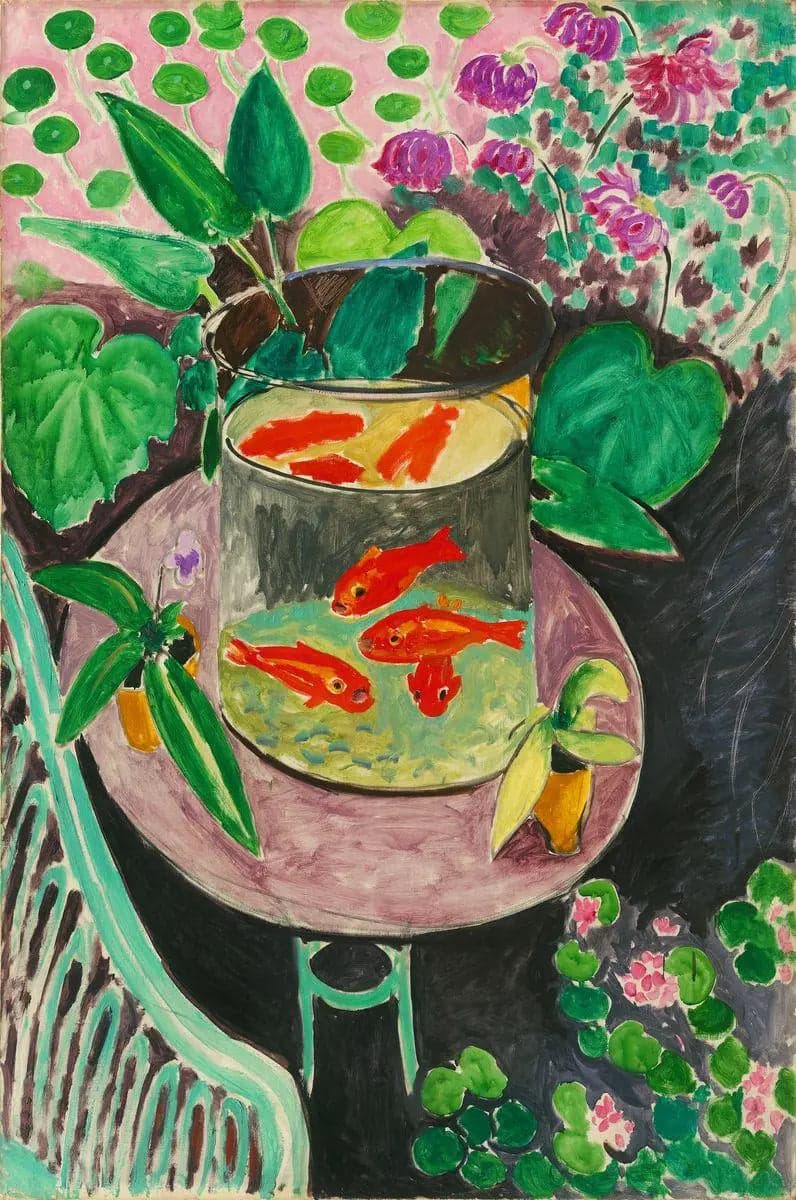
The Goldfish
- Original dimensions
- 98 x 140 cm
- Museum
- Pushkin State Museum of Fine Arts
- Year
- 1912
Scene depicted
In this composition , the goldfish play the protagonists of a peaceful scene bathed in light. The reflections in the water, the delicate shadows, and the touches of vibrant colors merge to bring to life an aquatic universe. It is a celebration of the joy of being, an immersion in a suspended moment where art captures ephemeral beauty.
Historical context
Created in 1912, during a time when art emancipates itself and rediscovers color, The Goldfish is part of the Fauvist movement. Located in Issy-les-Moulineaux, this work becomes a witness to a moment when Matisse explores emotions through forms. Today, the painting is carefully preserved at the Pushkin State Museum of Fine Arts , where its chromatic richness and captivating depth can amaze every visitor.
Place in the artist's career
The Goldfish marks a period of maturity in Matisse's career, a masterpiece of his research on color and light. Alongside The Dance and The Joy of Life , one can see the evolution of his technique and his growing boldness, the result of a time when art becomes a means of radical personal expression.
Anecdote
“Color is a thought,” said Henri Matisse , recalling that day of inaudible tranquil inspiration. While contemplating his goldfish, he was able to recreate an atmosphere of suspended serenity, a reflection of his own inner world and his quest for beauty. The emotion felt at that moment resonates powerfully in this painting , making every note of color vibrate.