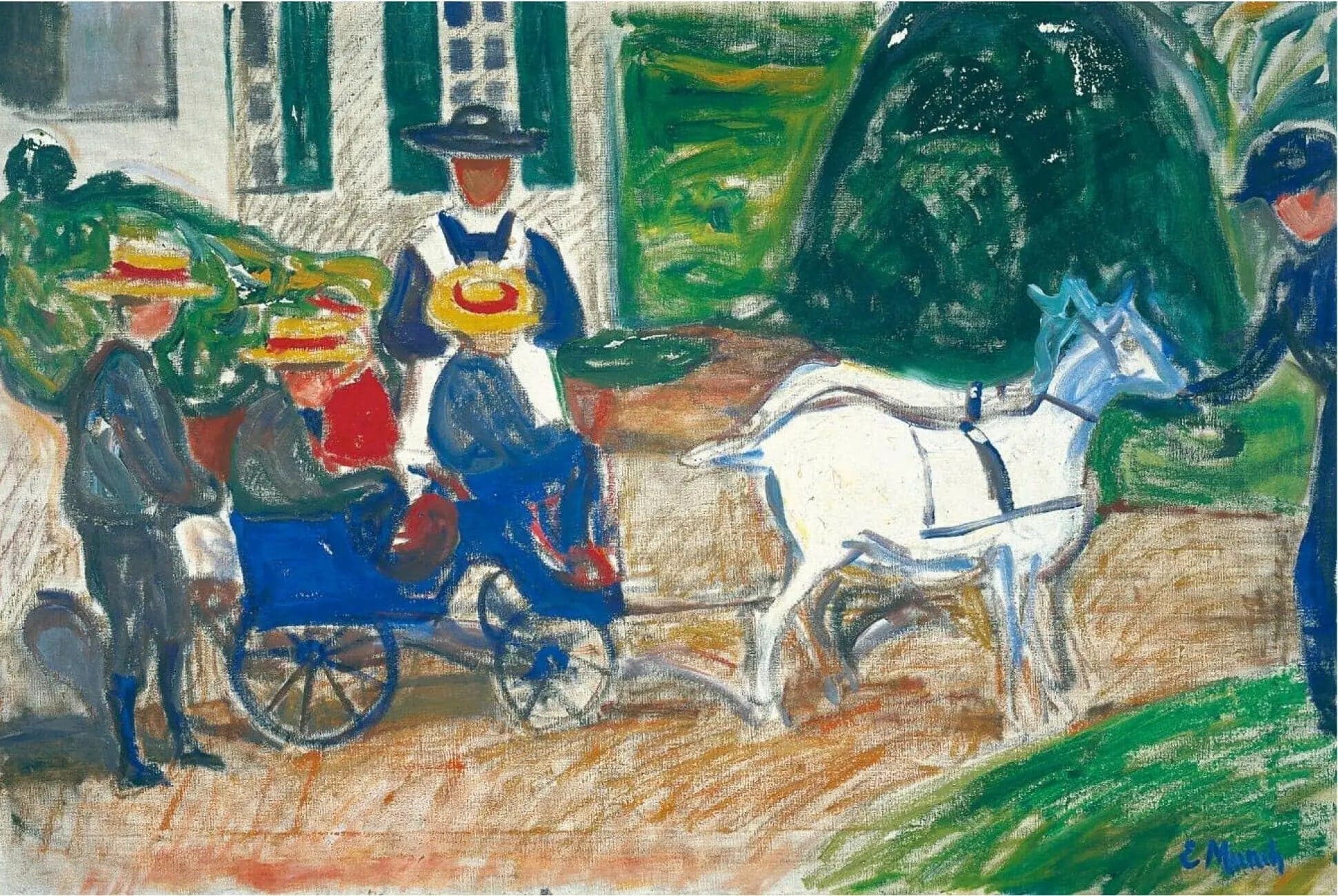
The Goat Cart
- Original dimensions
- 93.8 x 63 cm
- Museum
- Not specified
- Year
- 1903
Scene depicted
The painting “The Cart with Goats” depicts a peasant guiding her cart, loaded with goats, along a sunlit road, bathed in golden light. The simplicity of the scene is striking, revealing a fleeting moment of rural life, where nature and man unite in a now-precious harmony. This painting is part of a tradition of landscape representation while being deeply personal.
Historical context
Created in 1903, The Cart with Goats is set against the historical backdrop of a transforming Europe, where expressionism begins to emerge as a dominant artistic movement. This canvas emblematic of Edvard Munch captures the essence of an era, embodying both modernity and a return to deeper, more humanistic themes. Unfortunately, the current location of this painting is not specified, but its grandeur matches its dimensions: 93.8 x 63 cm.
Place in the artist's career
This canvas , although less known than his famous works like “The Scream,” marks a turning point in Munch's career. The painting stands out for its ability to evoke deep, human emotions. It marks a step towards a more intimate understanding of his subjects, accompanied by a parallel evolution in his other paintings that explore the human condition from another perspective.
Anecdote
Munch once stated: “I paint my memories.” It is easy to imagine what he felt while painting The Cart with Goats , undoubtedly inspired by a morning walk in a Norwegian countryside where the gentle sounds of animals and the smells of damp earth surrounded him. The calm atmosphere of that summer morning nourishes this pictorial work .