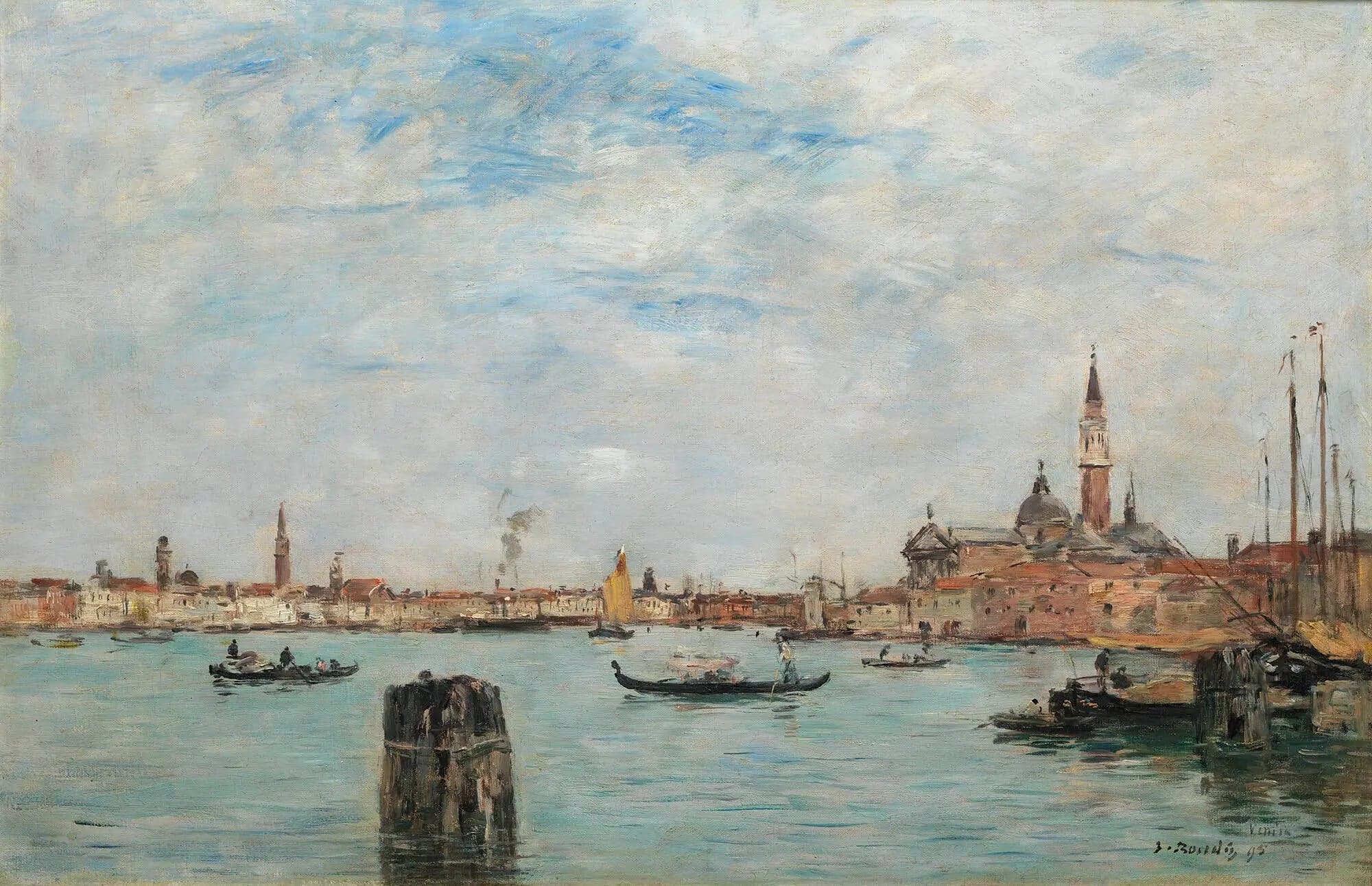
The Giudecca Canal and San Giorgio Maggiore, Venice
- Original dimensions
- 58 x 36.5 cm
- Museum
- Joslyn Art Museum
- Year
- 1895
Scene depicted
The canvas delicately represents the Giudecca Canal, bordered by the iconic church of San Giorgio Maggiore. This pictorial work captures an ephemeral moment, where the reflections in the water dance under the sun's rays. Boudin, master of light, evokes here the harmony between Venetian architecture and the surrounding nature, offering the observer an invitation to daydream.
Historical context
Created in 1895, this painting emblematic of Eugène Boudin is part of the Impressionist movement, a style that sought to capture the fleeting wonder of landscapes in natural light. The canvas is currently housed at the Joslyn Art Museum , a prestigious setting for this pictorial work, whose dimensions are perfectly proportioned, 58 x 36.5 cm, to offer a total immersion in its Venetian hues.
Place in the artist's career
This painting marks a crucial turning point in Boudin's career, reflecting his stylistic maturity. Previously, his works like “The Port of Trouville” and “The Beaches of Normandy” already celebrated coastal scenes, but with this canvas , he reaches new heights of mastery by playing with light and water. This transition reveals the evolution of his art, placing him at the heart of Impressionism .
Anecdote
“The light of Venice is a muse with a thousand faces,” Boudin might have said while contemplating this breathtaking panorama. This moment when he captured the magic of the canal, bathed in light, illustrates the wonder and poetic strength of the painting . The artist managed to convey a vibrant atmosphere, full of promises and tranquility.