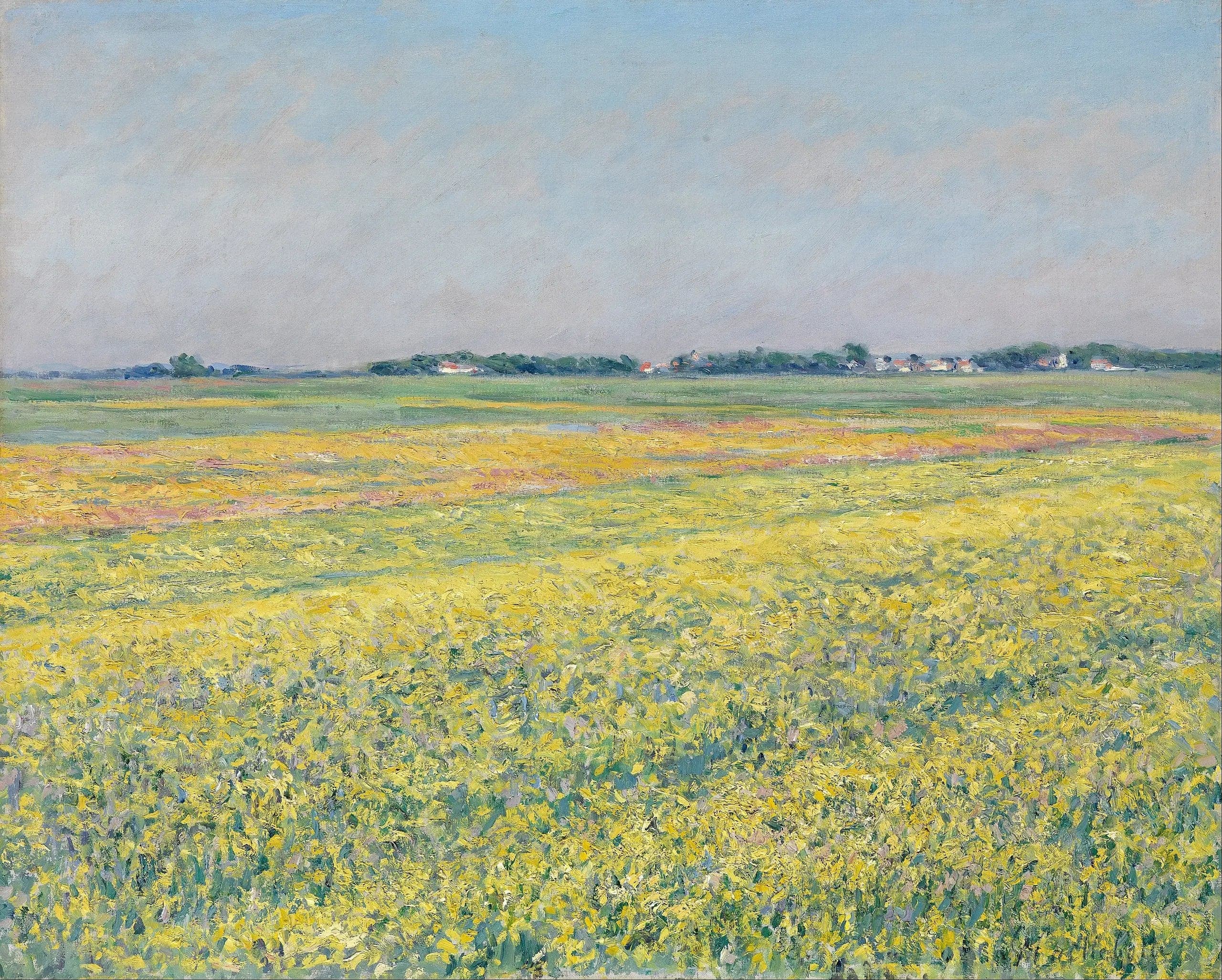
The Gennevilliers Plain, Yellow Fields
- Original dimensions
- 65.4 x 54.5 cm
- Museum
- Wallraf-Richartz Museum
- Year
- 1884
Scene depicted
In this painting , Caillebotte depicts a field of wheat swaying in the breeze, bathed in warm golden light. The vibrant hues capture the ephemeral beauty of the flora, while the bright sky merges with the horizon. Each brushstroke evokes the rustling of the ears and the sweet scent of blossoms, a true immersion in this living nature.
Historical context
Created in 1884, this painting is emblematic of the Plain of Gennevilliers, near Paris. Gustave Caillebotte , a master figure of the Impressionist movement, immerses us in a rural setting where daylight filters through the open fields. Currently, this magnificent canvas is displayed at the Wallraf-Richartz Museum , a true showcase of pictorial art. Its dimensions, modest yet powerful, give it an intimate, captivating presence.
Place in the artist's career
This canvas , although less known than other paintings by the master, represents a pivotal moment in his career. It illustrates his explorations of vast spaces while being less intimate than his earlier works such as “The Floor Scrapers” or “A Balcony in Paris.” Here, Caillebotte asserts himself in his mastery of light and color treatment.
Anecdote
“Nature inspires me, each canvas is a moment suspended in time,” Caillebotte once said. Imagine him walking through the fields on a spring morning, as the sun's rays dance on the golden flowers; the scene he captures in this masterpiece becomes a celebration of life itself, a tribute to the splendor of landscapes.