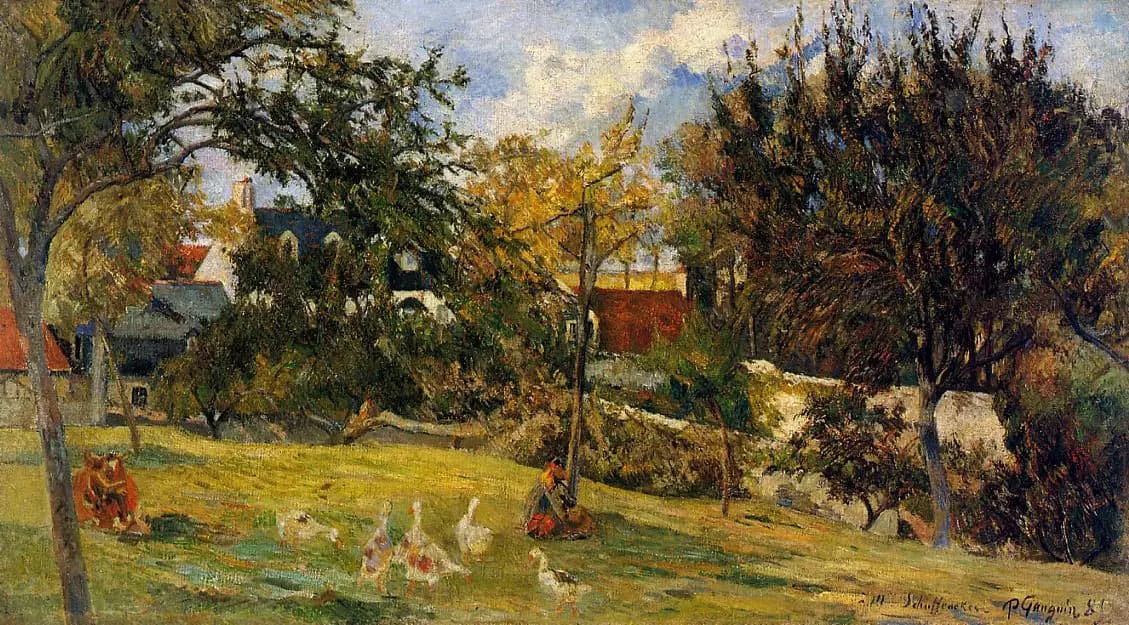
The Geese in the Meadow, or Farm in Normandy
- Original dimensions
- 100 x 56 cm
- Museum
- Portland Museum of Art
- Year
- 1885
Scene depicted
This painting is an ode to bucolic simplicity. At the heart of a verdant meadow, the geese move gracefully, bearing witness to the apparent calm of rural life. The vibrant hues of nature intertwine to suggest an exhilarating tranquility. Through this composition, Gauguin not only illustrates a moment but whispers to us the story of a daily life imbued with serenity and beauty.
Historical context
Created in 1885, this painting comes to life under the creative gaze of Paul Gauguin , one of the pillars of the post-impressionist movement. Located in Normandy, the cradle of enchanting landscapes, the work captures the essence of a time when art awakens to color and emotion. Today, the magnificent canvas is displayed at the Portland Museum of Art, where it continues to teach and inspire, measuring 100 x 56 cm of pure pictorial poetry.
Place in the artist's career
The Geese in the Meadow represents a pivotal moment in the career of Paul Gauguin , reflecting his rise within the post-impressionist movement. Between this canvas and other iconic works such as “The Vision After the Sermon” and “Where Are We Going?”, one can perceive a notable technical evolution, a quest for a more liberated, more intense artistic expression.
Anecdote
“Every brushstroke is a breath of life on the canvas,” he once declared, thus expressing his deep connection with nature. It was on a golden spring morning that he was carried away by the beauty of this meadow, where the geese majestically floated like musical notes on a silent score, a fleeting moment immortalized in his masterpiece .