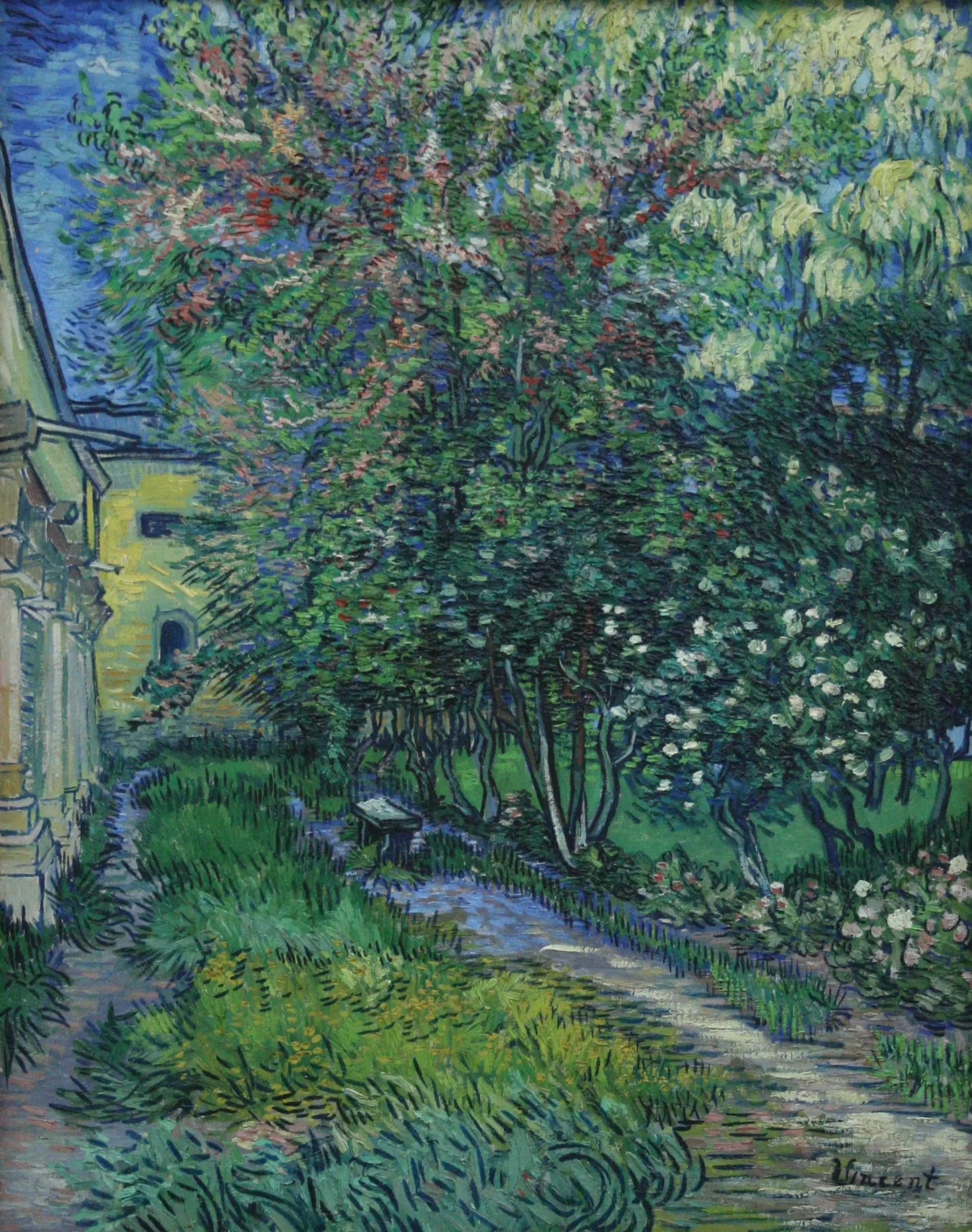
The Garden of the Asylum at Saint-Rémy
- Original dimensions
- 75.5 x 95 cm
- Museum
- Kröller-Müller Museum
- Year
- 1889
Scene depicted
This enchanting painting captures a flourishing garden, where nature blooms in an explosion of colors. Van Gogh's dynamic brushstrokes evoke both the serenity and turbulence of his mind, an incessant struggle between external beauty and internal chaos. Each element of this composition is an ode to life, embedded in the black and blue of the canvas.
Historical context
Created in 1889, in the charming town of Saint-Rémy-de-Provence , The Garden of the Asylum of Saint-Rémy belongs to the post-impressionist movement. This painting , now displayed at the Kröller-Müller Museum , is set against a rich and troubled artistic context, reflecting Van Gogh's inner struggle during this crucial period of his career.
Place in the artist's career
The Garden of the Asylum of Saint-Rémy stands as a cornerstone in Van Gogh's career, marking his journey towards individual expression. Parallel to other iconic pieces such as The Sunflowers and Van Gogh's Bedroom in Arles , this painting illustrates the stylistic peak of an artist always in search of authenticity.
Anecdote
Vincent van Gogh once stated: “I dream of the canvas all night and wake up wondering how to capture it by day.” It is in this asylum garden, bathed by the first light of the sun, that the artist drew his inspiration, one spring morning when the scent of flowers mingled with the cries of birds. This atmosphere merges with the spiritual strength of this pictorial work .