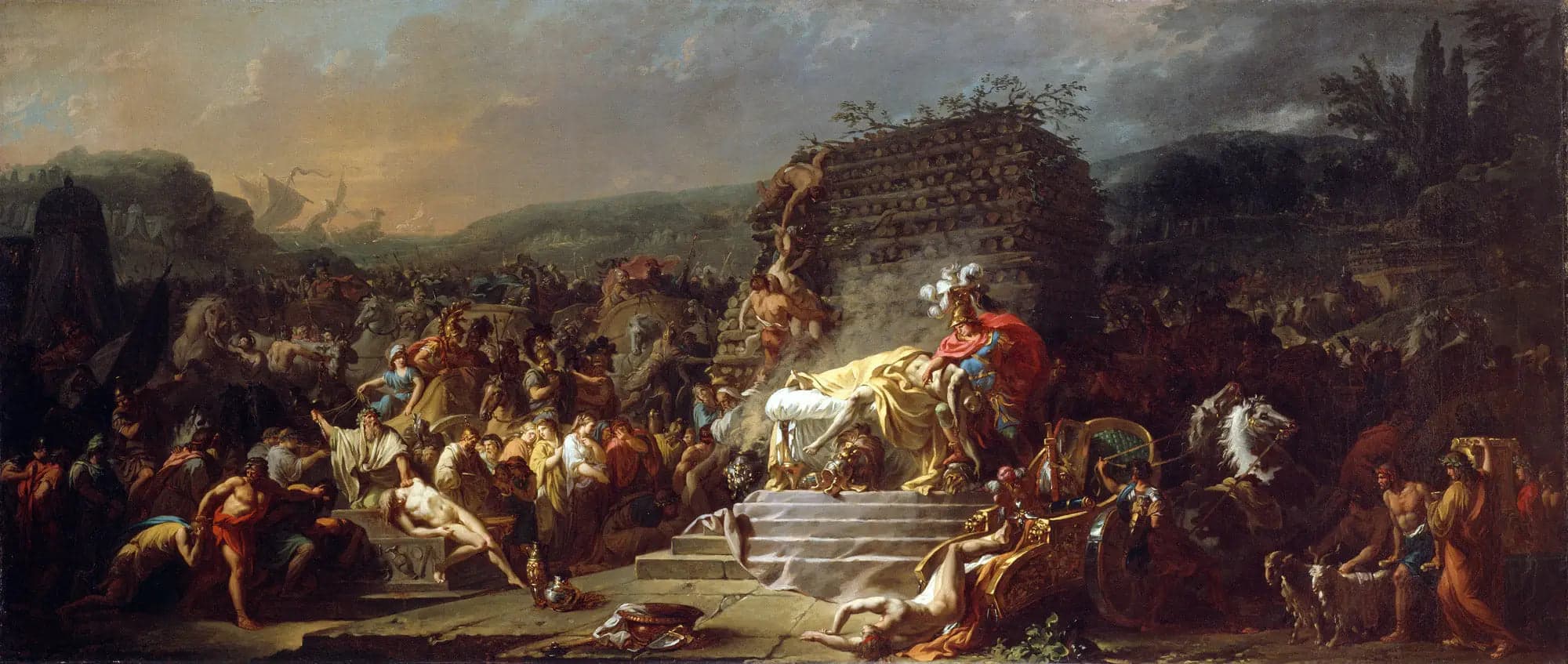
The Funeral of Patroclus - Jacques
- Original dimensions
- 218 x 94 cm
- Movement
- neoclassicism
- Museum
- National Gallery of Ireland
- Year
- 1778
Scene depicted
This painting illustrates the drama of the death of Patroclus, hero of the Iliad, whose body is arranged for a dignified funeral. In an atmosphere of reflection, David manages to capture the majesty of grief and the heroism of the characters present, emphasizing the emotional impact that the loss of a friend can generate.
Historical context
Created in 1778 in Paris, this painting is emblematic of neoclassicism , an artistic movement that celebrates a return to the values of ancient Greece. The painting, now displayed at the National Gallery of Ireland , measures 218 x 94 cm and reflects a time when art drew its inspiration from historical and mythological narratives.
Place in the artist's career
The Funeral of Patroclus represents a turning point in David's career, marking a period of experimentation and artistic maturity. Alongside The Oath of the Horatii and The Sabines , his previous paintings display stricter compositions, while this painting paves the way for a deeper expression and a more narrative approach to art.
Anecdote
Jacques-Louis David once confided to a friend: "My brush is one with the pain of antiheroic tragedy." He was inspired by a touching scene, on a rainy morning in Paris, where the absence of the sublime was felt. This moment of revelation allowed him to capture the emotional force of his masterpiece , The Funeral of Patroclus .