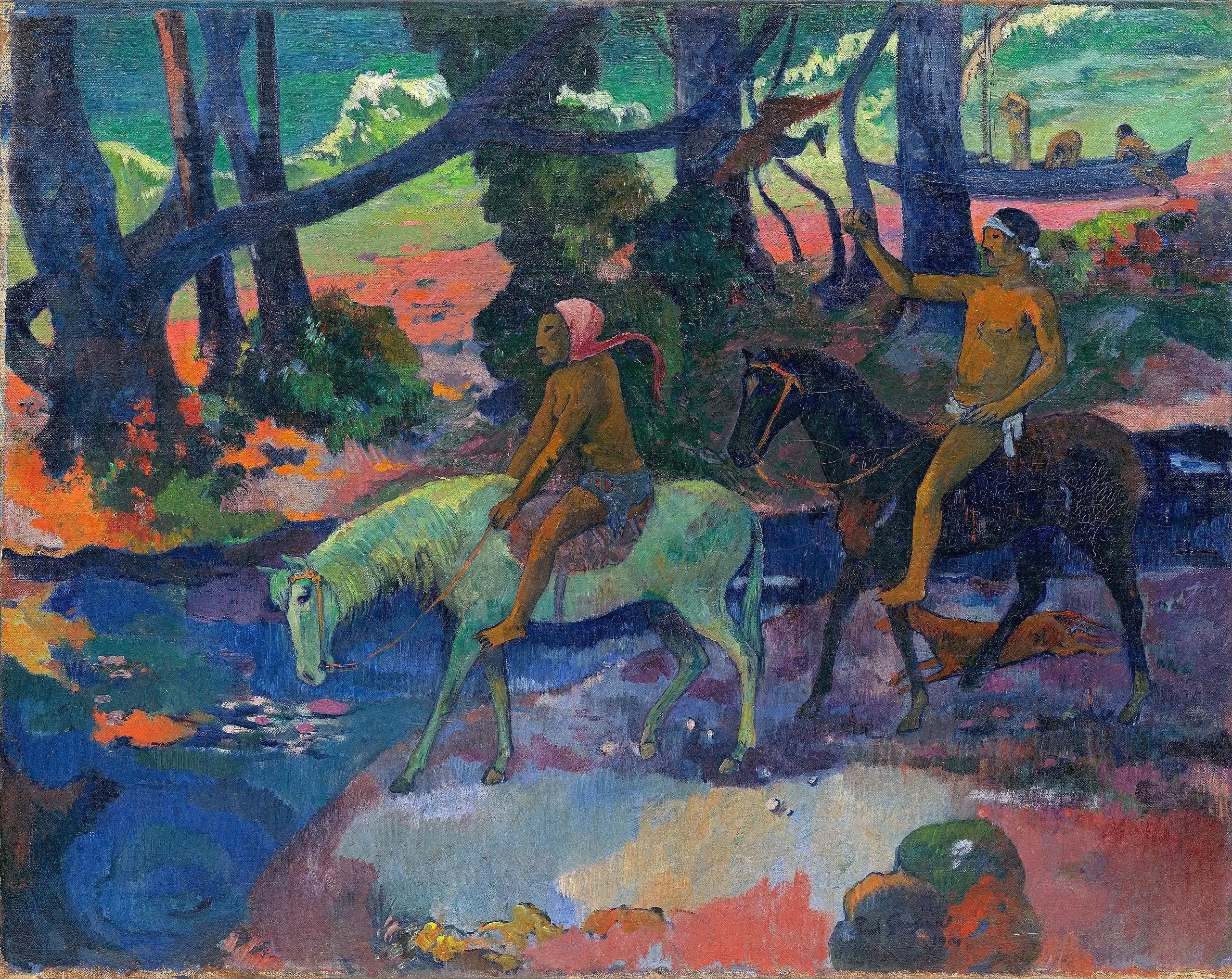
The Ford
- Original dimensions
- 95 x 76 cm
- Museum
- Pushkin State Museum of Fine Arts
- Year
- 1901
Scene depicted
The painting “The Ford” depicts a bucolic panorama, a meeting between man and nature, following the path of a clear stream. The characters portrayed, simple and authentic, seem to evolve in harmony with their environment. It is a sanctuary, a space where one can escape the tumult of the modern world, an invitation to contemplation.
Historical context
Created in 1901, this iconic work finds its origin at the crossroads of influences from post-impressionism . Located in Moscow, at the Pushkin State Museum of Fine Arts , this canvas is a vibrant testimony to Gauguin's artistic journey and the movements that marked his time. Far from the realistic techniques of the 19th century, this painting reveals emotional depth and a personal interpretation of nature.
Place in the artist's career
The Ford represents a significant milestone in the career of Paul Gauguin , characterized by an increasingly bold style. This painting is part of a period of maturity, where the painter asserted his artistic individuality. Compared to “The Vision After the Sermon” and “The Women of Tahiti,” “The Ford” reveals an evolution towards delicate abstraction, playing with forms and colors to express deep emotions.
Anecdote
“Painting is a cry of the soul,” Gauguin said. One sunny morning, by the edge of a tranquil river, he felt the whisper of life. This moment of inspiration transformed into a pictorial work, where each brushstroke tells a story, a secret. The Ford, both peaceful and captivating, crystallizes this essence.