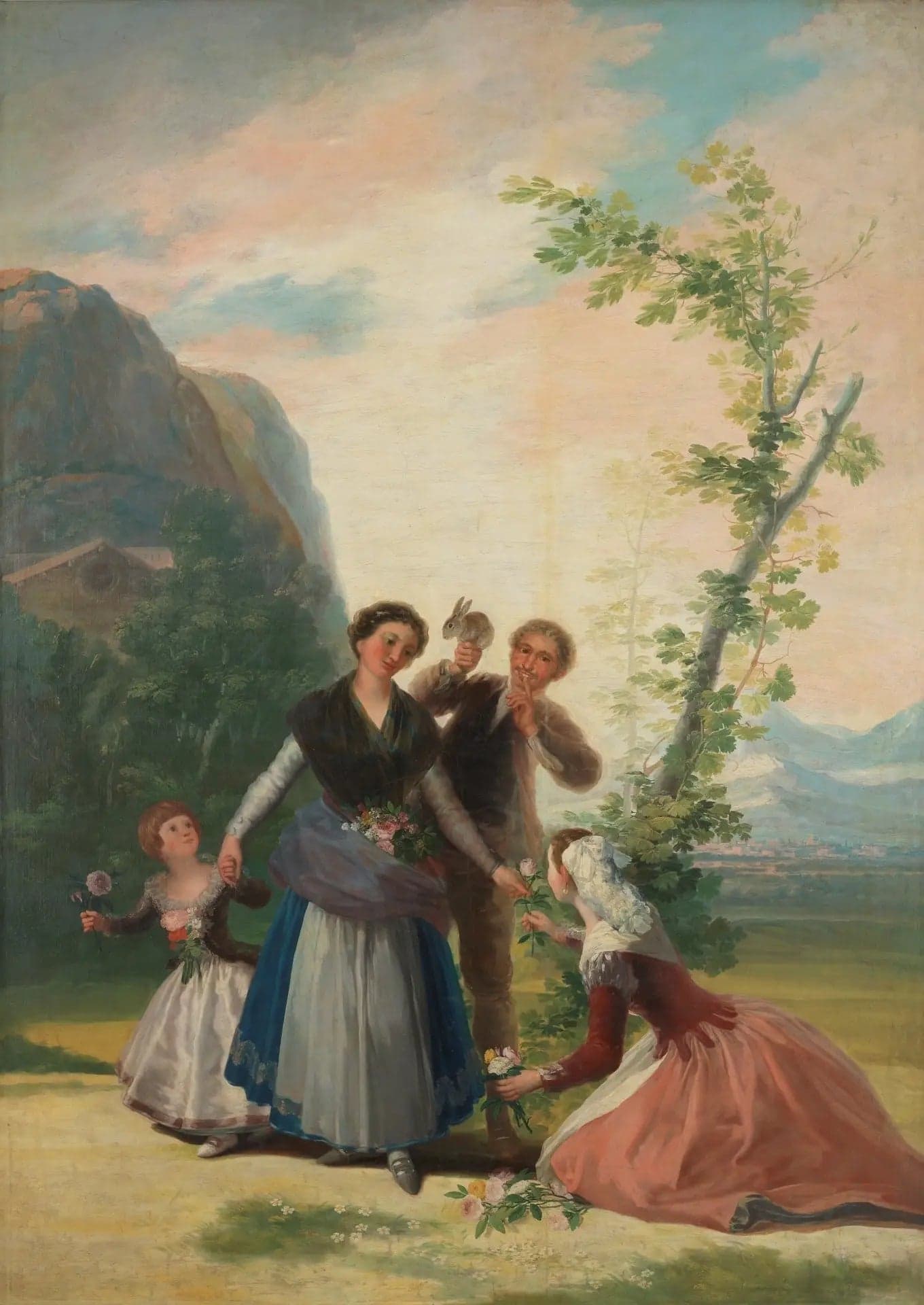
The Flowers
- Original dimensions
- 192 x 277 cm
- Museum
- Prado Museum
- Year
- 1786
Scene depicted
This pictorial masterpiece evokes the delicate beauty of flowers, a symbol of the spring season, capturing their brilliance under a bright sky. Through refined details, Goya manages to capture the essence of nature, transforming simple vegetation into a tableau of emotions and sensations where each petal seems to vibrate with its own life.
Historical context
Created in Madrid, this painting dates back to 1786, a period marked by the romantic movement that was gradually emerging, captivating the minds of contemporary artists. The work The Flowers , now carefully preserved in the Prado Museum, is set against a vibrant cultural backdrop where art becomes a reflection of a time in full transformation.
Place in the artist's career
The Flowers marks an important milestone in Goya's mature period, where he succeeds in combining technique and sensitivity. Compared to his earlier works such as The Majas on the Balcony and The Family of Charles IV , this canvas represents an evolution towards a softer light, a more contemplative approach that reveals a new perspective on the natural world.
Anecdote
“Nature is my muse, and only it can dictate emotion.” It was on a gentle spring morning, in the heart of a silent alley, that Goya drew inspiration for this canvas . The evocative power of The Flowers testifies to this intimate connection between the artist and his living environment.