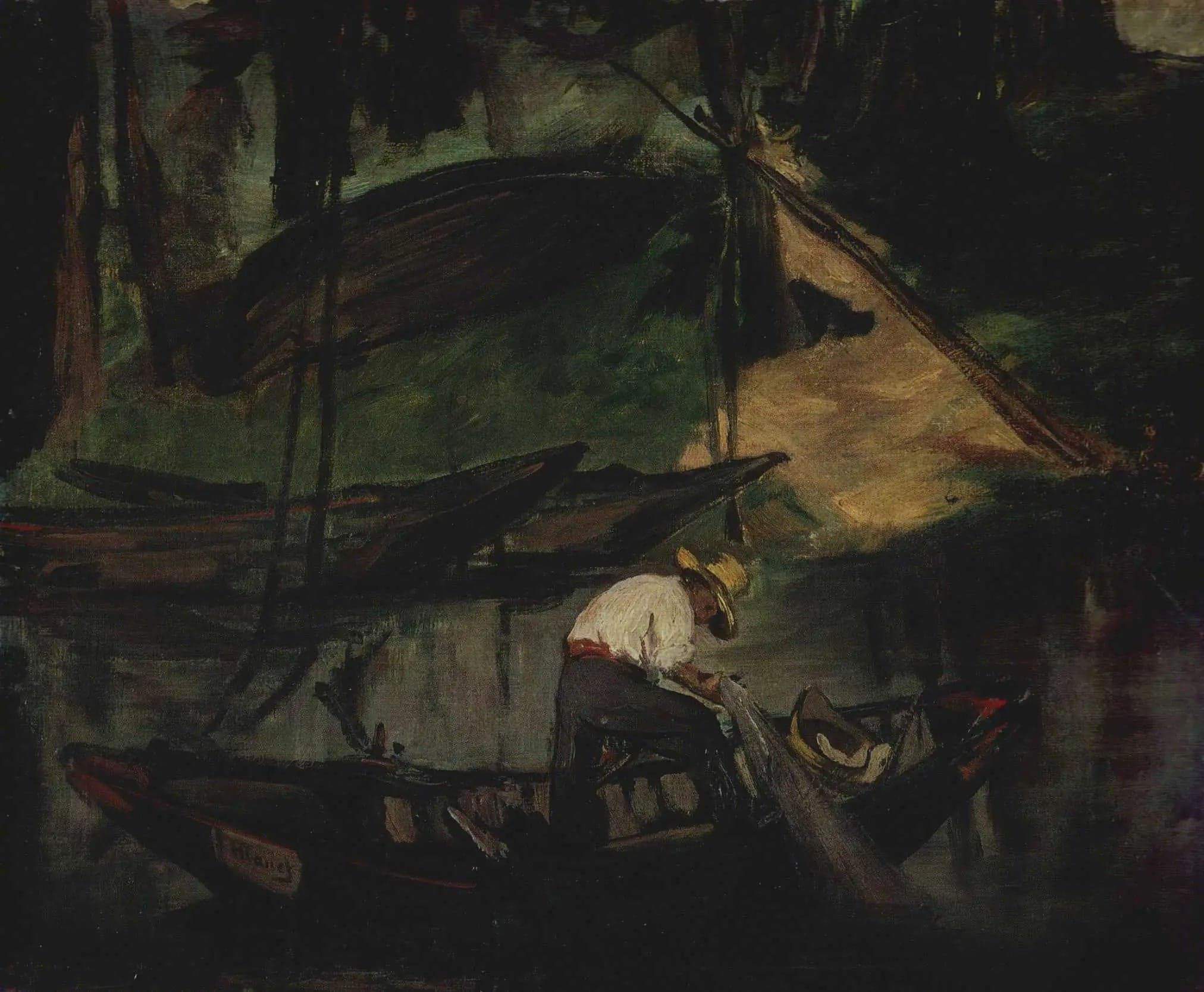
The Fisherman
- Original dimensions
- 56 x 46 cm
- Museum
- Von-der-Heydt Museum
- Year
- 1862
Scene depicted
In The Fisherman , Manet immerses us in a dynamic painting that balances tranquility and rural authenticity. We see a man, focused and calm, fishing, almost in communion with nature. The meticulous details of the reflections on the water and the surrounding branches transport us to a suspended space-time, inviting reflection on the sacred bond between man and his environment.
Historical context
Created in 1862, this painting exemplifies its roots in 19th century Paris, a time when Impressionism began to shake the foundations of traditional art. Édouard Manet , an emerging figure of this movement, captured the essence of his time through his canvas . Currently, the canvas is preserved at the Von-der-Heydt Museum in Germany, testifying to European admiration for this pictorial work. The dimensions of 56 x 46 cm add to the closeness and intimacy that this canvas offers.
Place in the artist's career
The Fisherman marks a pivotal step in Manet's career, illustrating his bold and innovative approach. Alongside Lunch on the Grass and Olympia , these canvases show an evolution towards a deeper exploration of light, color, and form, highlighting his transition from academic artist to master of the modern movement.
Anecdote
Manet is said to have once stated: "Life is a blank canvas, it is up to us to paint our story." This statement resonates intensely in The Fisherman , a work born on a sunny morning by the banks of the Seine; the artist captured a moment where light gently embraces the scene, almost like a caress, inspired by the tranquil movement of the water.
Major exhibitions
Edouard Manet