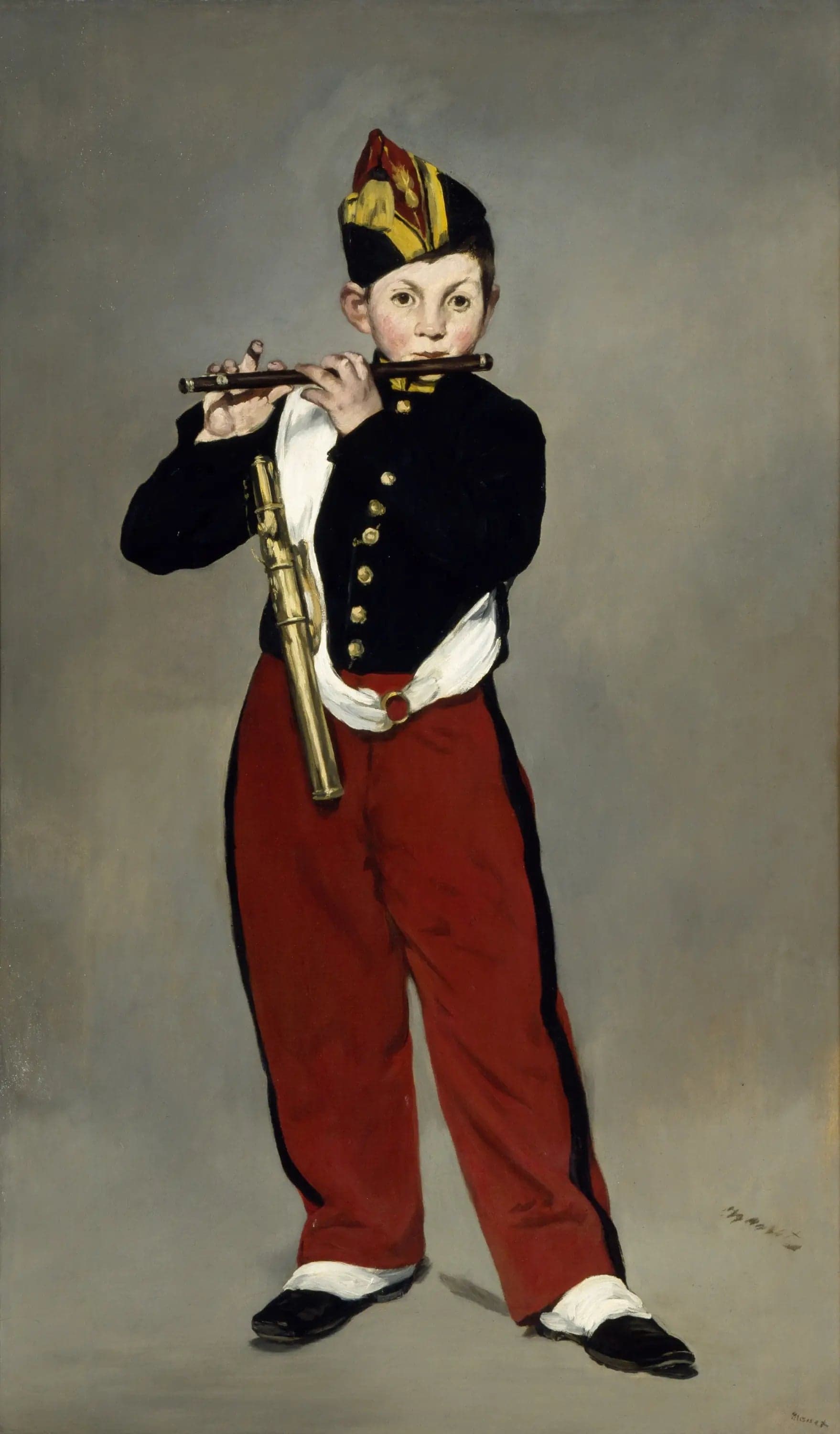
The Fifer
- Original dimensions
- 97 x 160.5 cm
- Museum
- Musée d'Orsay
- Year
- 1866
Scene depicted
The painting depicts a young boy playing the flute, surrounded by a musical and vibrant atmosphere. Establishing a sound dialogue between the canvas and the viewer, the work opens a window into the world of childhood and popular culture, capturing a lost innocence and a moment of escape.
Historical context
Created in 1866 in Paris, this painting occupies a central place in the Impressionist movement. Édouard Manet , master of art in the 19th century, captured a vibrant and modern essence of his time. Today, the painting resides at the Musée d'Orsay, where it continues to fascinate visitors with its impressive dimensions.
Place in the artist's career
The Fifer is part of a pivotal period in Manet's career, symbolizing his shift towards a bolder approach to painting . Compared to his other works like Déjeuner sur l'herbe and Olympia , it demonstrates an increased mastery of light and color, signifying the evolution of his pictorial style in reaction to the conventional.
Anecdote
“Painting is never a mere reflection; it is a voice of the soul.” Reflecting on these words, Manet recalled a sunny morning when he observed a young musician in an alley in Montmartre. The expressive force of that moment shaped the composition of his masterpiece , The Fifer .
Major exhibitions
1889 World's Fair in Paris