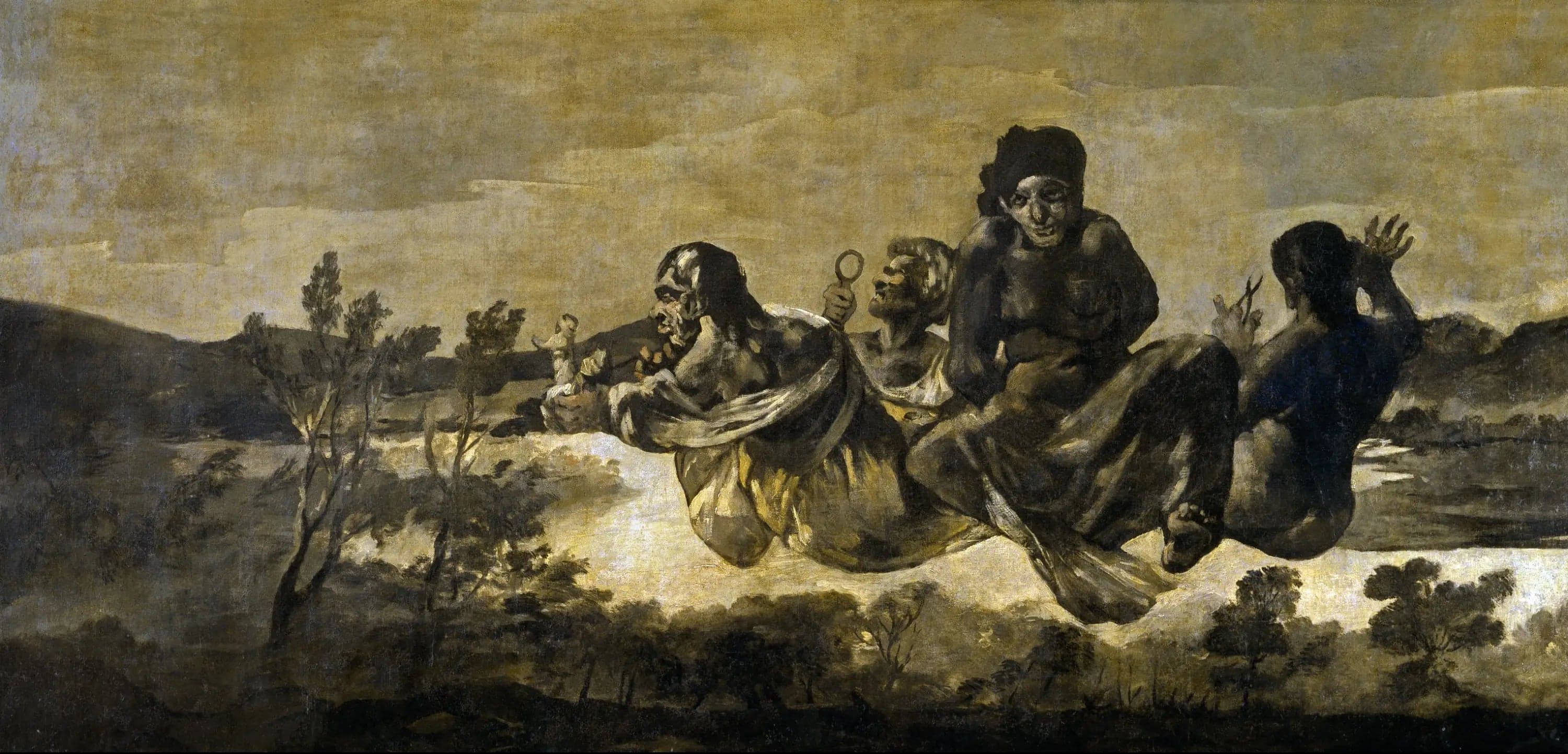
The Fates
- Original dimensions
- 266 x 123 cm
- Museum
- Prado Museum
- Year
- 1819
Scene depicted
In "The Fates," Goya immerses us in a resolutely dark and tragic tableau, representing the three deities of fate, Clotho, Lachesis, and Atropos, who, through their threads, weave human lives. The work explores the inescapable theme of fate, capturing a moment where the future of each individual lies in the hands of these powerful mythological figures. It is a composition that sublimates anguish and fatality, through the mastery of shadows and light.
Historical context
Created in 1819, the painting emblematic "The Fates" comes to life in the heart of Madrid, Spain, during a period marked by political and social upheaval. As a major work associated with the Romantic movement, it stands out for its profound emotional impact, reflecting both anguish and the quest for freedom. Today, this canvas is housed in the Prado Museum, where it continues to amaze the public with its imposing dimensions.
Place in the artist's career
"The Fates" establishes itself as a pillar in Goya's career, marking the transition to a more expressive and emotional style. Placing it alongside works such as "The Third of May 1808" and "The Naked Maja," one perceives Goya's evolution towards a more introspective and engaging pictorial language, transcending simple outlines to touch the soul.
Anecdote
"Art is a mirror of human suffering," Goya might have said as he contemplated one foggy morning, palette in hand. It is in this silence, interrupted only by the song of birds, that he drew inspiration for his masterpiece . The evocative power of this painting reflects his deep commitment to the human condition.