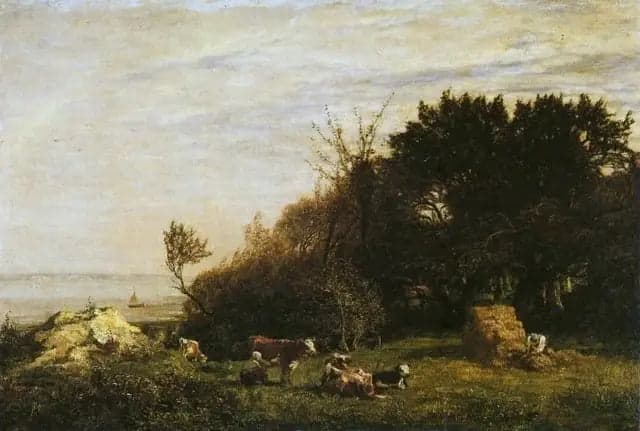
The Farm of Saint-Siméon, surroundings of Honfleur
- Original dimensions
- 74 x 50 cm
- Museum
- Not specified
- Year
- 1856
Scene depicted
The painting "The Farm of Saint-Siméon, near Honfleur" represents an idyllic vision of the Norman countryside. The canvas depicts a rustic farm surrounded by lush fields and varied skies, where the sky comes alive with shades of blue and white evoking changing atmospheres. The viewer's gaze is drawn to the harmony between nature and the modest architecture of the farm, creating a dialogue between humanity and its environment.
Historical context
Created in 1856, this painting is emblematic, emerging in the picturesque setting of Saint-Siméon, near Honfleur, in the heart of Normandy. Boudin, a leading figure of the Impressionist movement, captures the essence of this era where natural light and the beauty of the Norman landscapes amaze artists. Currently, the canvas is not listed in a renowned museum, adding mystery and charm to its history.
Place in the artist's career
This canvas occupies a prominent place in Boudin's career, marking a period when he perfected his style. In parallel, his other works such as "The Beaches of Normandy" and "The Promenade at Trouville" illustrate the evolution of his approach. "The Farm of Saint-Siméon" represents the maturity of his style, where the influence of plein air becomes fully visible.
Anecdote
"It is essential to paint outdoors, where nature speaks to us," said Boudin. On that spring morning when inspiration struck him, he could smell the scents of flowers emerging from the damp earth. The morning glow of light gently caresses the shadows of the trees and defines the contours of this canvas , transcending the simple act of creation to become a sensory experience.