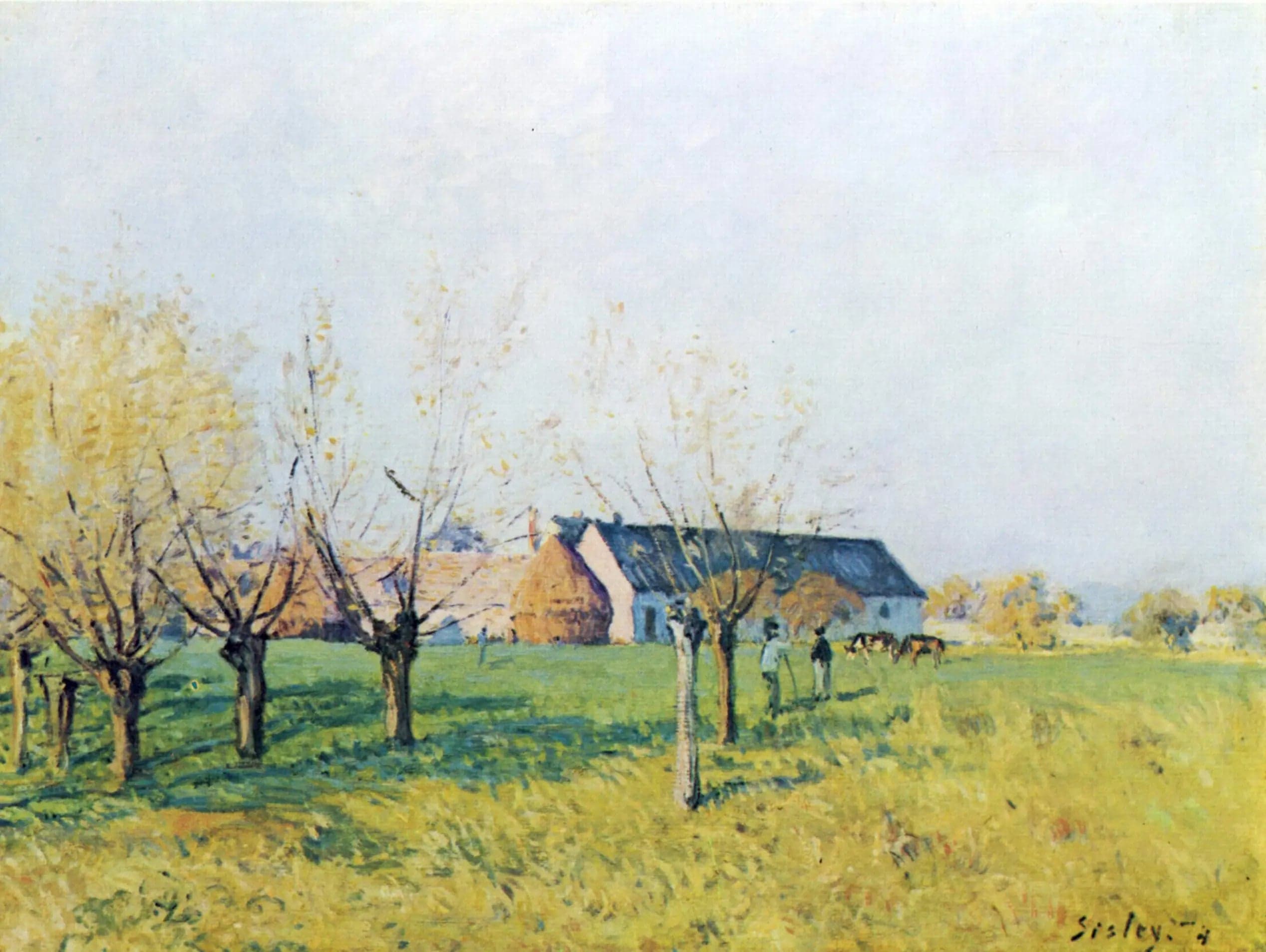
The Farm of Hell Hole, Autumn Morning
- Original dimensions
- 62 x 47 cm
- Museum
- High Museum of Art
- Year
- 1874
Scene depicted
This painting transports us to the heart of a peaceful reality, where the fermentation of colors and textures evokes the harmony of a day when nature seems to delight in its own reflection. Sisley enhances this rural landscape by capturing the soft light that filters through the branches of the trees, thus creating a serene and calming atmosphere. The gaze is guided by a dirt path that invites us to explore this vibrant environment of life and colors.
Historical context
Created in 1874, this painting signed by Alfred Sisley is part of the Impressionist movement that marked the end of the 19th century in France. Located in Bougival, a charming town on the banks of the Seine in the Paris region, this canvas captures the essence of autumn mornings, where nature awakens in a gentle whisper. Today, this painting is preserved at the High Museum of Art , thus offering art enthusiasts the opportunity to reconnect with this intimate creation.
Place in the artist's career
In the career of Alfred Sisley , The Farm of the Hell Hole, autumn morning is situated at a decisive turning point. It is a period of maturity where his Impressionist style reaches a perfect balance between light and color. Alongside works such as The Bridge of Villeneuve-la-Garenne and The Sails, Brittany , one perceives a stylistic evolution where Sisley increasingly masters the art of capturing fleeting moments of nature.
Anecdote
“Nature is my greatest muse; every morning, I awaken the memory of a world that flourishes in every nuance of light.” These words of Alfred Sisley resonate like an echo before this pictorial work. Imagine the master, surrounded by the gentle rays of the rising sun, allowing himself to be inspired by the poetic silence of the autumn morning, directly on the motif of the painting .