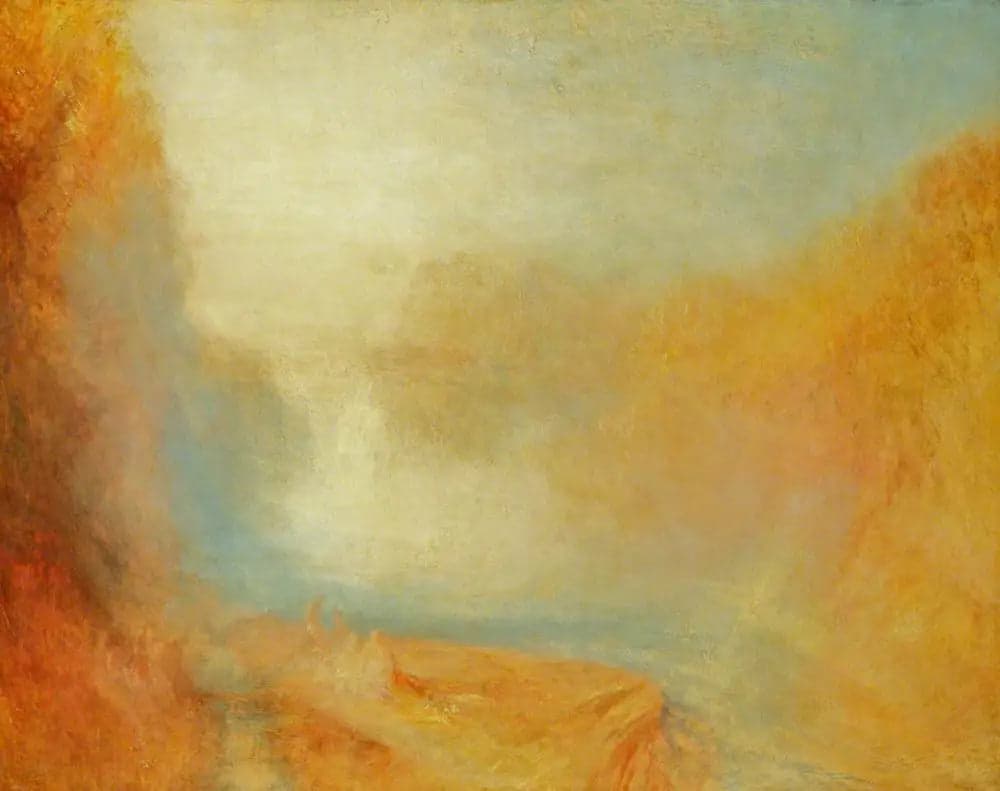
The Falls of the Clyde
Scene depicted
The painting “The Falls of the Clyde” masterfully illustrates the beauty of the falls in the heart of the Scottish Highlands. Turner, through tumultuous cascades and golden light, captures the very essence of the wild and majestic nature of Scottish rivers. The work evokes both beauty and power, offering the viewer an immersion into this natural environment.
Historical context
Created in 1805 in London, this painting is emblematic of the romantic movement. J. M. W. Turner, a pioneer of impressionism , conceived this work at a time when England celebrated nature and the sublime. Currently housed at the National Galleries of Scotland in Edinburgh, this canvas measures 90 x 123 cm.
Place in the artist's career
This painting marks a decisive turning point in Turner’s career, demonstrating stylistic maturity. It can be paralleled with “The Decline of the Sea” and “The Snow Storm,” illustrating his evolution towards colorful abstraction, where light and movement become the protagonists.
Anecdote
“Light is the master of emotion,” Turner is said to have remarked while contemplating the falls in the early morning. This moment of grace infused the evocative power of The Falls of the Clyde , a painting where nature reveals itself in all its splendor.