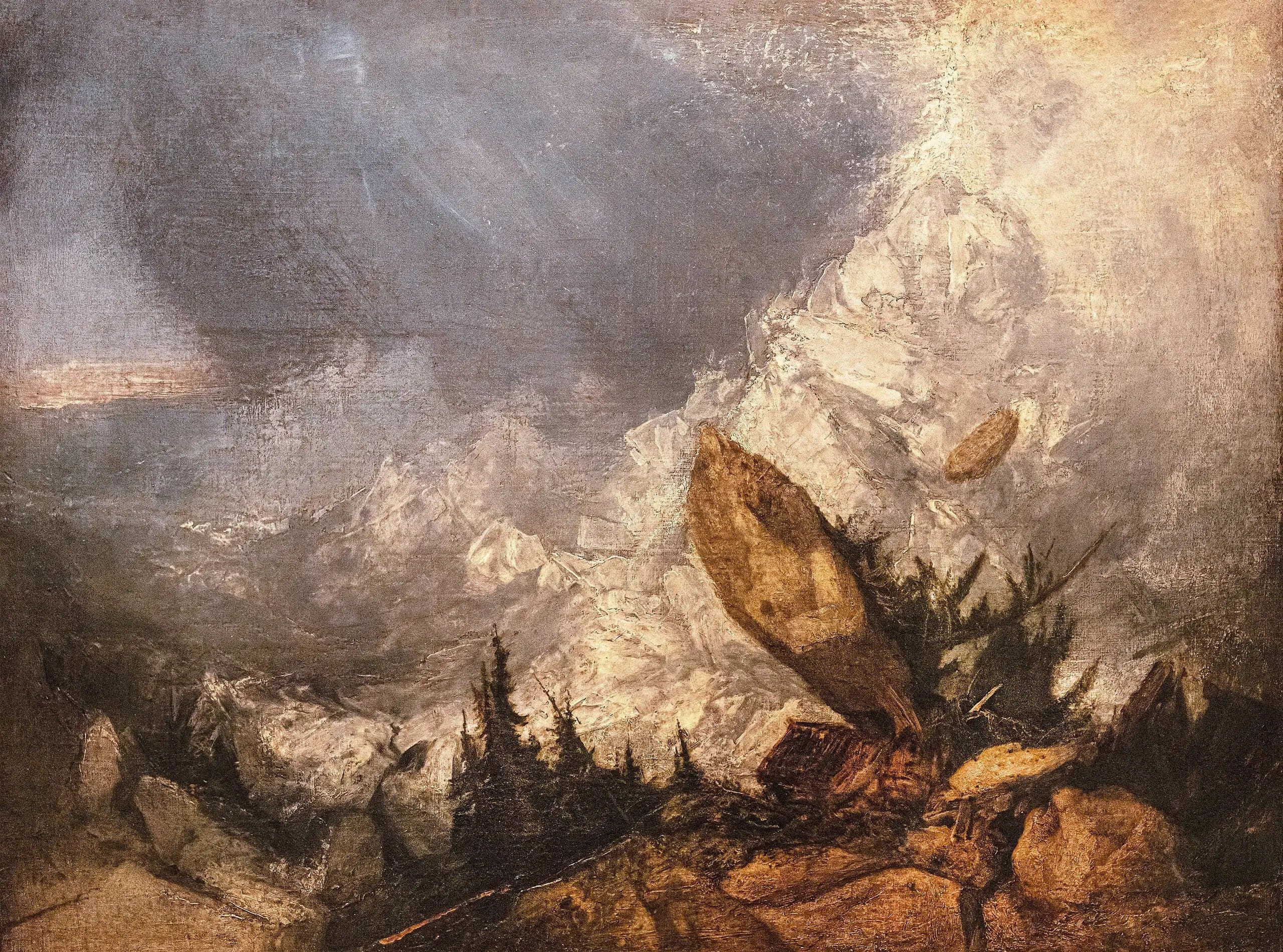
The Fall of an Avalanche in the Grisons
- Original dimensions
- 120 x 90.2 cm
- Museum
- Tate
- Year
- 1810
Scene depicted
This canvas depicts a dramatic moment where the snow cascading down the steep slopes of the Grisons seems to engulf everything in its path. The force of the natural elements is palpable, paying tribute to the tumultuous energy emanating from the canvas. Turner, with his mastery of light and movement, manages to capture the ephemeral essence of a tragic scene, imbued with both beauty and dread.
Historical context
Created in 1810, at the height of the Romantic era, this painting emblematic of J. M. W. Turner leaves his artistic mark in London, within the movement that celebrates sublime nature and human emotion. His canvas , exhibited at the Tate , embodies the essence of the sublime, measuring 120 x 90.2 cm, and still resonates today with the strength of its historicity.
Place in the artist's career
This The Fall of an Avalanche in the Grisons stands as a turning point in Turner’s career, revealing his ability to marry technique and emotion. At this time, he merges his style with works such as Rain, Steam and Speed and The Fighting Temeraire , reflecting an evolution towards a bolder exploration of themes of nature.
Anecdote
Turner once declared: “Art must capture the moment when light plays with shadow in a dance of the elements.” He found inspiration for this masterpiece during a mountain journey, fascinated by the natural power of an avalanche, on a misty morning where the intertwined colors evoked both danger and beauty.