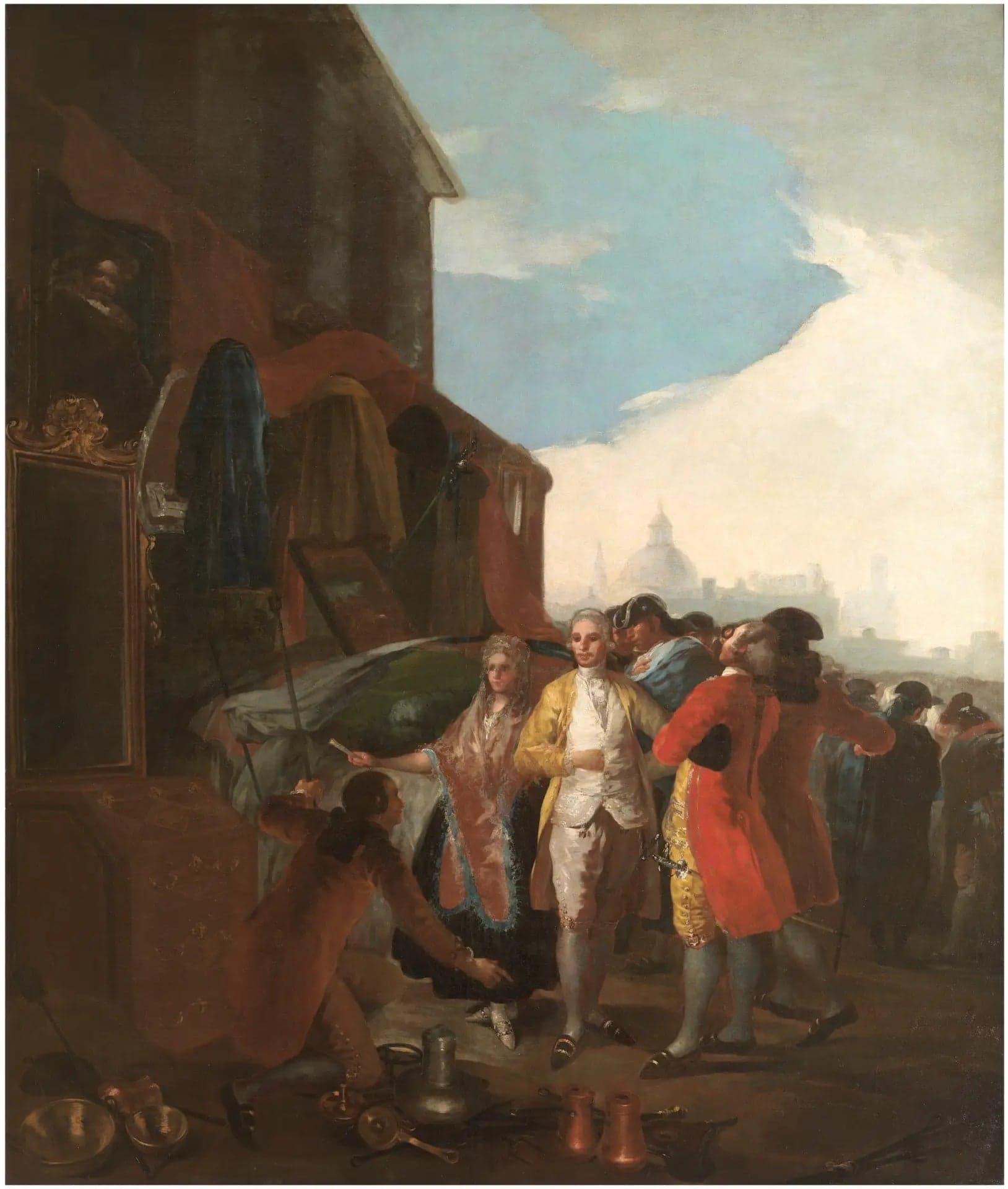
The Fair of Madrid
- Original dimensions
- 218 x 258 cm
- Museum
- Prado Museum
- Year
- 1778
Scene depicted
The painting “The Fair of Madrid” depicts a lively scene of daily life, where the crowd indulges in the festivities of the fair. The characters intertwine in a dance of human interactions, embodying joy, music, and the tumult of a central event in Madrid life, where traditions and convivialities disrupt the routine.
Historical context
This painting , created in 1778, is set in the vibrant backdrop of Madrid in the 18th century. This canvas reflects the romantic movement and the beginnings of realism , thus placing Goya at the heart of an artistic era in full swing. Currently exhibited at the Prado Museum in Madrid, this celebrated painting offers us a window into a lively popular world.
Place in the artist's career
This painting , situated at the peak of Goya's career, represents a pivotal period. From a pioneering realism to a more introspective style, it can be compared to “Las Meninas” by Velázquez for its masterful treatment of perspective, and to “The Charge of the Mamelukes” for the raw emotion it conveys. This reflects the artistic evolution of a master in search of truth.
Anecdote
“Art is a mirror that reflects not only life but the very soul of our time,” Goya might have said while referring to his canvas . Imagine a spring morning, bathed in golden light, where a sudden inspiration struck him as he observed the frenzy of a lively fair, each face vibrant with emotions.