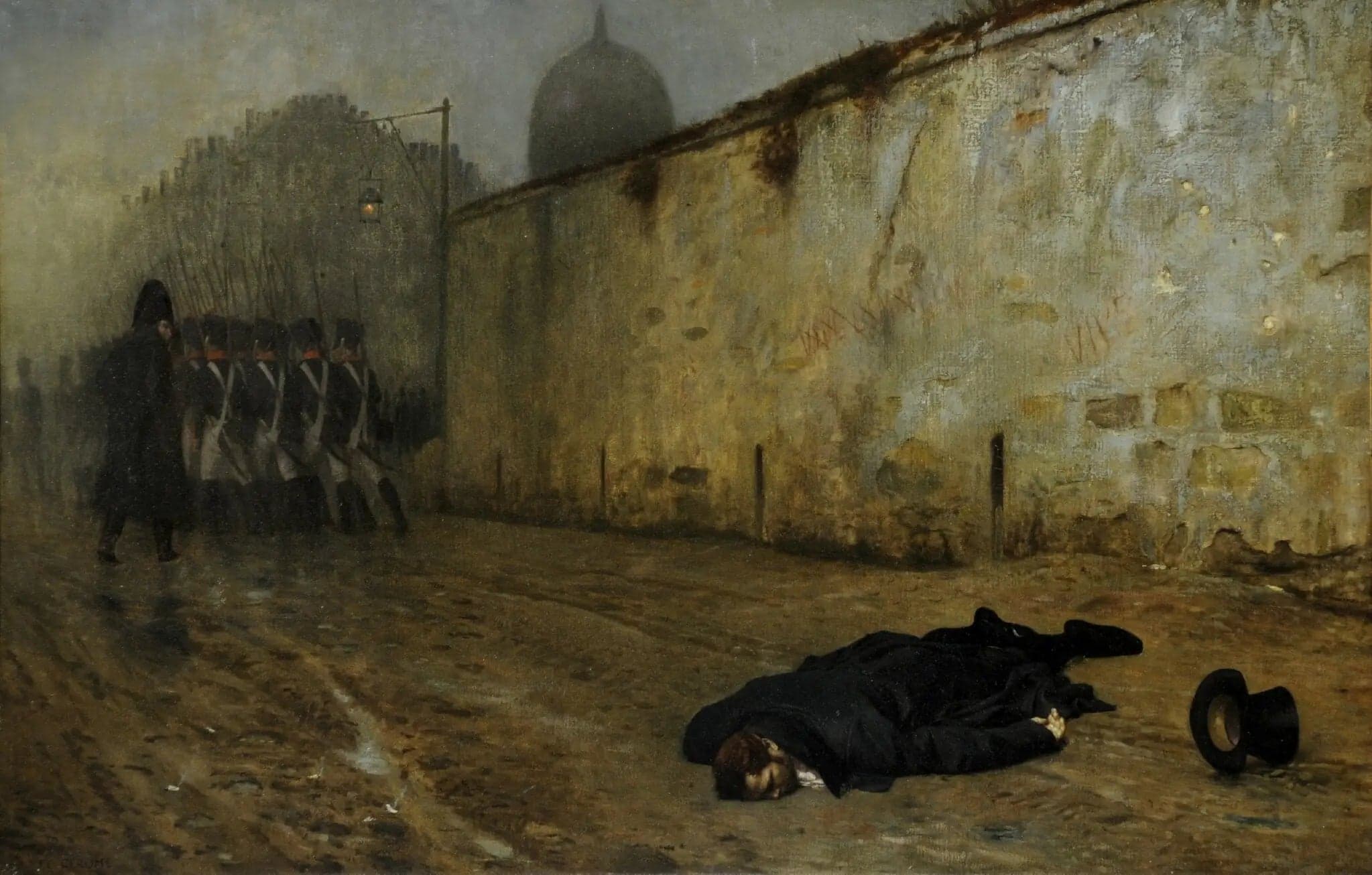
The Execution of Marshal Ney - Jean
- Original dimensions
- 104.2 x 65.2 cm
- Museum
- Graves Art Gallery
- Year
- 1868
Scene depicted
This painting dramatically represents the poignant scene of the execution of Marshal Ney, one of the emblematic figures of the Napoleonic Wars. Capturing the solemn moment where sadness and duty meet, the work depicts Ney's final moments, thus exposing human emotions in all their complexity. Gérôme's realism leaves no viewer indifferent, making this scene both historical and profoundly human.
Historical context
Created in 1868, the painting "The Execution of Marshal Ney" by Jean-Léon Gérôme is rooted in the tumultuous milieu of 19th century France. This era, marked by the Revolution and the Napoleonic Wars, inspires much of Gérôme's work, which belongs to the academic movement . The painting is now displayed at the Graves Art Gallery, where it fascinates visitors with its impressive dimensions.
Place in the artist's career
The Execution of Marshal Ney marks a turning point in Gérôme's career, showcasing his artistic maturity. In parallel, other emblematic paintings like "Pollice verso" and "The Dance of the Insane" illustrate the evolution of his style, shifting from a fascination with exoticism to a more introspective analysis of historical themes.
Anecdote
"Art must reconstruct the truth in all its nuances." such could be Gérôme's creed as he works on his masterpiece . He seems to have drawn inspiration from a summer afternoon, where the whispers of a warrior past still resonate in the cobbled streets, whispering to him the vibrant details of his painting .