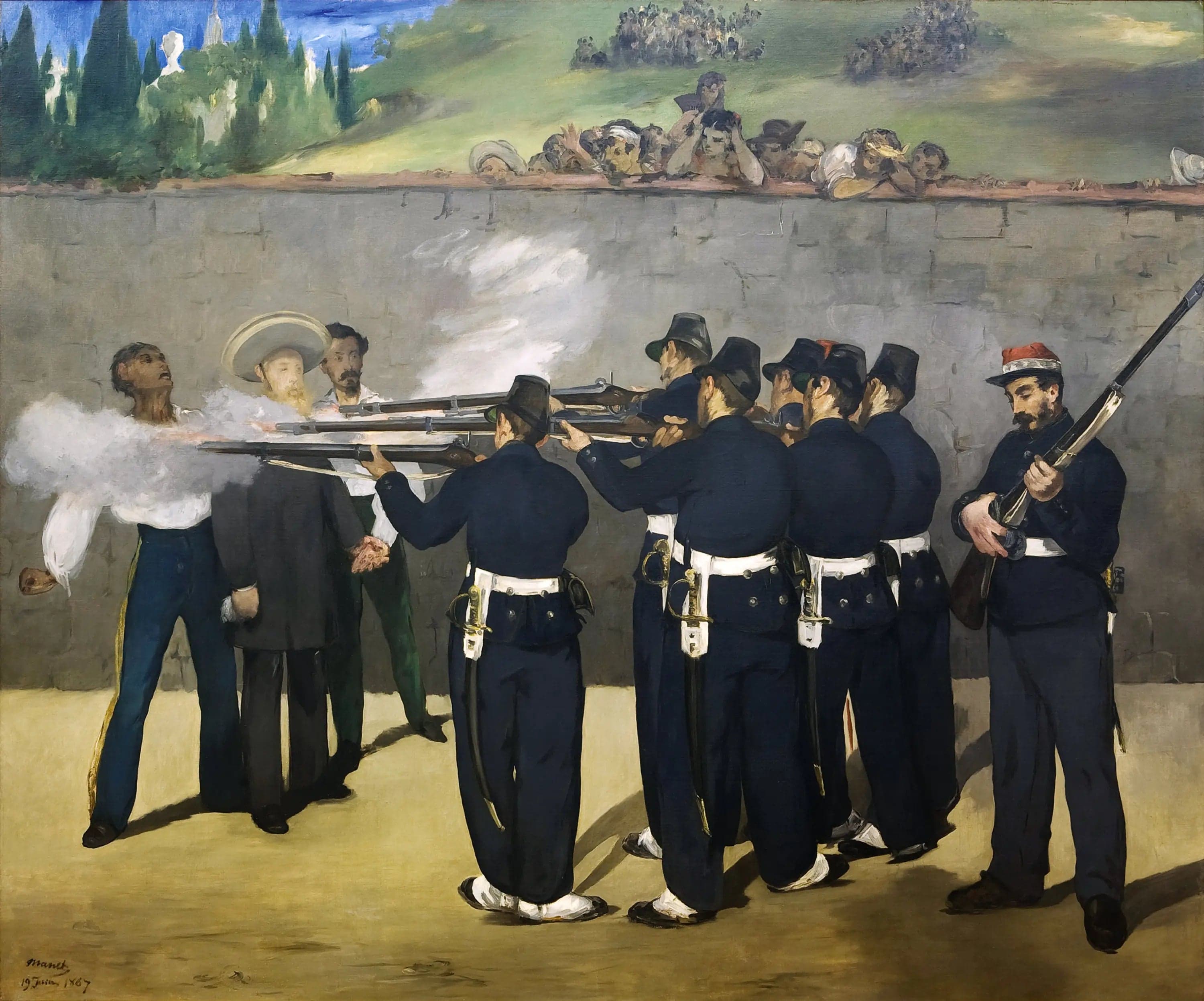
The Execution of Emperor Maximilian
- Original dimensions
- 302 x 252 cm
- Museum
- Kunsthalle Mannheim
- Year
- 1868
Scene depicted
This painting illustrates the execution of Emperor Maximilian of Mexico, an act laden with historical consequences. Manet, through his unique talent, not only shows the horror of this scene but transports us into the intensity of the emotions of the participants — the despair of the soldiers, the determination of a sovereign in the face of death. This pictorial work does not merely depict an event: it questions our own perceptions of justice and human dignity.
Historical context
Created in 1868, this painting captivates with its boldness and innovation. Édouard Manet , an iconic figure of realism and a precursor of impressionism , created this canvas in the turbulent context of 19th century France, a time marked by political and social upheaval. His masterpiece now rests at the Kunsthalle Mannheim , offering an immersive experience to visitors. This painting, with its impressive dimensions, captures a tragic historical moment, immortalizing an episode where fate and human choices intertwine.
Place in the artist's career
The Execution of Emperor Maximilian stands as a significant work in Manet's career, marking a turn towards controversial and moving subjects. Alongside Le Déjeuner sur l'herbe and Olympia, this canvas reflects Manet's evolution, from his technical innovations to his impactful social messages. The emotional richness of this work reveals an artist in full maturity, ready to challenge conventions.
Anecdote
Manet often said: “Painting is the echo of the soul.” Inspired by tales of fallen heroes, he made this canvas a poignant cry of revolt against injustice. Imagine him, one spring morning, in his studio, contemplating the troubled face of a friend eager for tales of heroism. It was this moment that awakened in him the desire to capture the essence of this painful moment.