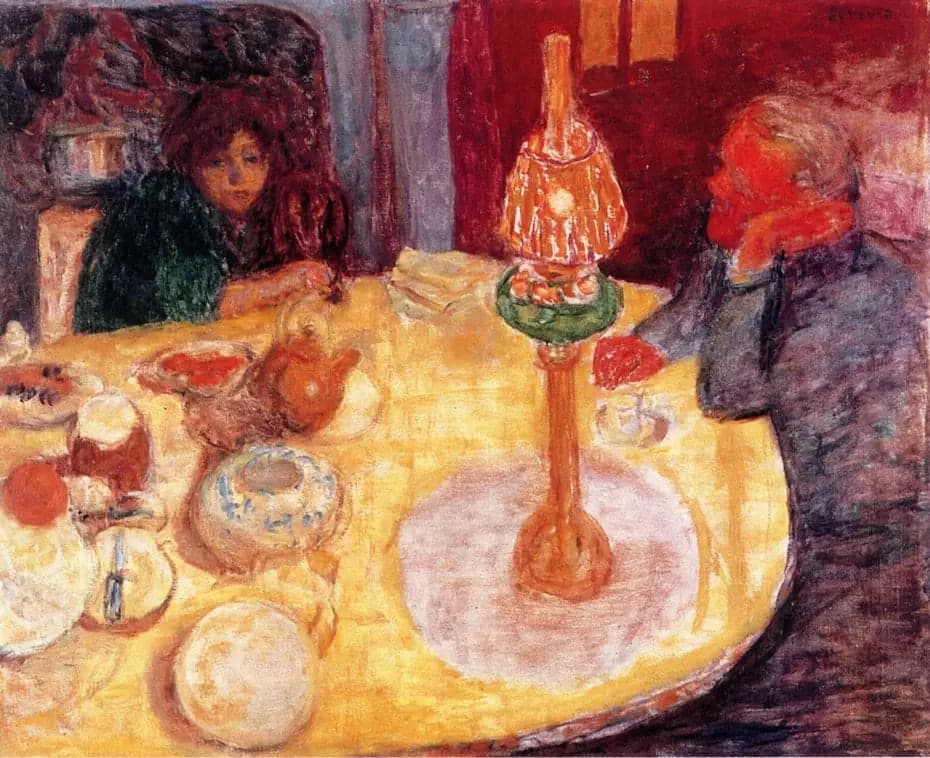
The Evening Under the Lamp
- Original dimensions
- 88.3 x 73.5 cm
- Museum
- Orsay Museum
- Year
- 1921
Scene depicted
The Evening Under the Lamp reveals an intimate scene where the characters are enveloped by a soft, almost caressing light. The pictorial composition immerses us in a universe where time seems suspended, a family or friendly gathering, disturbed by the play of shadows and lights generated by the lamp. It is a painting where emotions collide, a space of sharing and complicity.
Historical context
It was in 1921 that Pierre Bonnard brought to life his painting The Evening Under the Lamp, an eloquent sign of a changing world, in Paris, at the heart of the Belle Époque. Evolving within the Nabi movement, the artist evokes the intimacy of a shared moment, during a time when artistic currents are reinventing themselves. Currently, this magnificent painting is located at the Orsay Museum , a Parisian sanctuary dedicated to the art of Impressionism and beyond.
Place in the artist's career
This painting is situated during a period of maturity for Bonnard, marked by an unprecedented harmonization between emotion and technique. After The Nude with Oranges and before The Great Days, The Evening Under the Lamp bears witness to an evolution of his style towards a more intimate and luminous approach, capturing the nuances of daily life with palpable emotion.
Anecdote
“Each painting is a window to the soul,” says Bonnard, inspired by the soft lighting of a peaceful evening. A quiet alley in Paris, enveloped by the scent of lilacs, awakened in him a deep serenity, soon captured in his canvas . The Evening Under the Lamp illustrates this, where each brushstroke resonates like an echo of that precious moment.