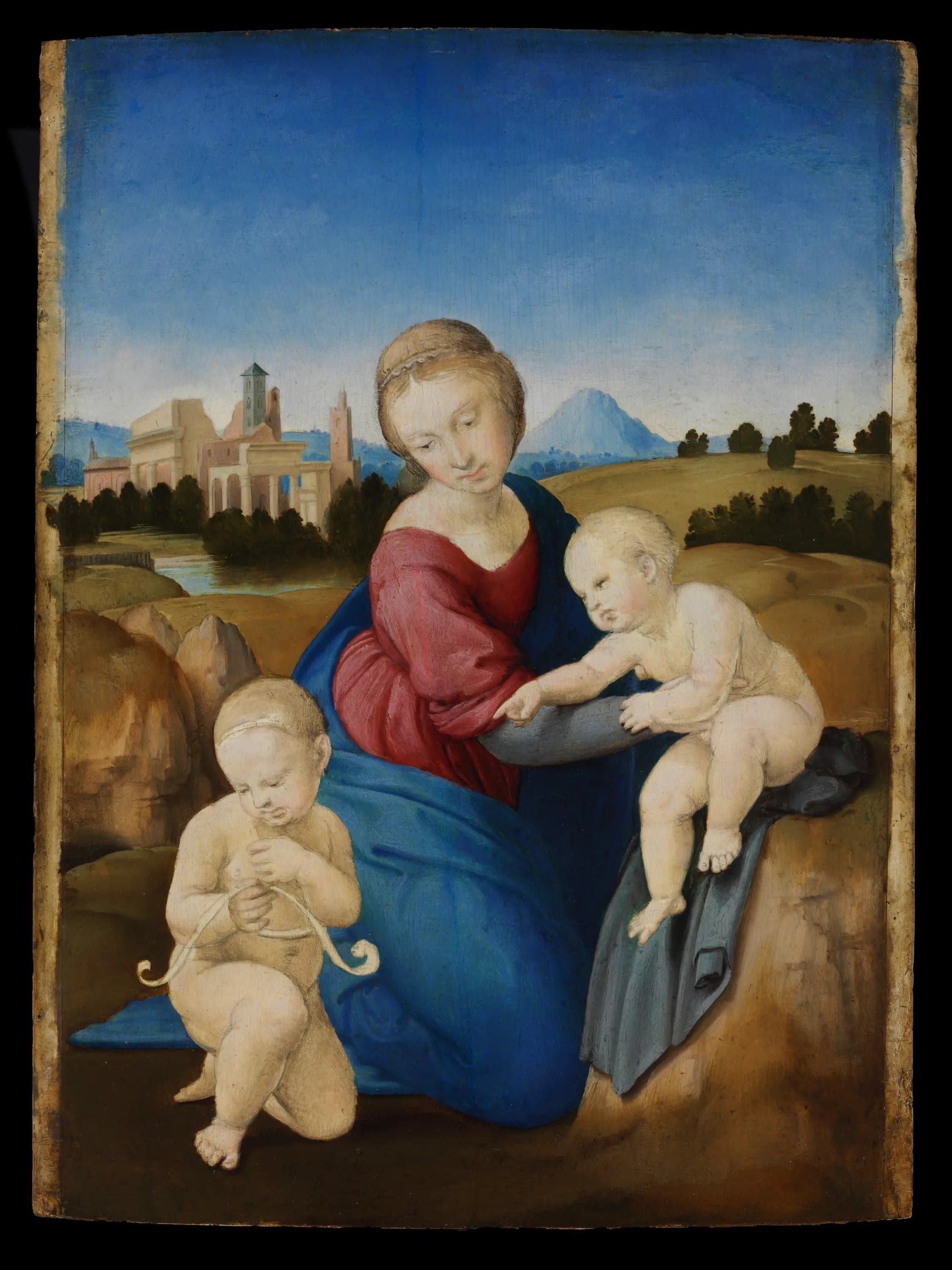
The Esterházy Madonna
- Original dimensions
- 21.5 x 28.5 cm
- Movement
- High Renaissance
- Museum
- Museum of Fine Arts in Budapest
- Year
- 1508
Scene depicted
This painting depicts the Virgin Mary, holding the child Jesus, bathed in a soft and comforting light. The tranquility of this maternal union unfolds in a rich and harmonious composition, each of the figures drawn with palpable tenderness. This pictorial work invites us to contemplate love and devotion, illustrating the depth of the bond between mother and child, a timeless theme that resonates through the centuries.
Historical context
Created in 1508, this painting is set against the vibrant backdrop of the High Renaissance , a movement that marked the rediscovery of humanist values. Located in Budapest, at the Museum of Fine Arts, this canvas of 21.5 x 28.5 cm captures the splendor of an era when art reached peaks of emotion and technique. Each brushstroke bears witness to the masterful legacy left by Raphael, whose artistic vision continues to enchant the world.
Place in the artist's career
The Esterházy Madonna is situated at the height of Raphael's career, an artist whose style would evolve towards more complex and emotionally charged compositions. In parallel, one can observe the evolution of his work through The Sistine Madonna and The Virgin with Chancellor Rolin , each revealing an increased mastery in the use of light and shadow that characterizes his unique style.
Anecdote
"It has appeared to me that beauty is not only found in the subject, but in the soul that expresses it." This quote, although fictional, perfectly illustrates the creative essence of Raphael. Imagine him, one spring morning in Florence, observing the passing faces, seeking inspiration for this incredible masterpiece . It is in the heart of this sparkling atmosphere that the inspiration for The Esterházy Madonna was born.