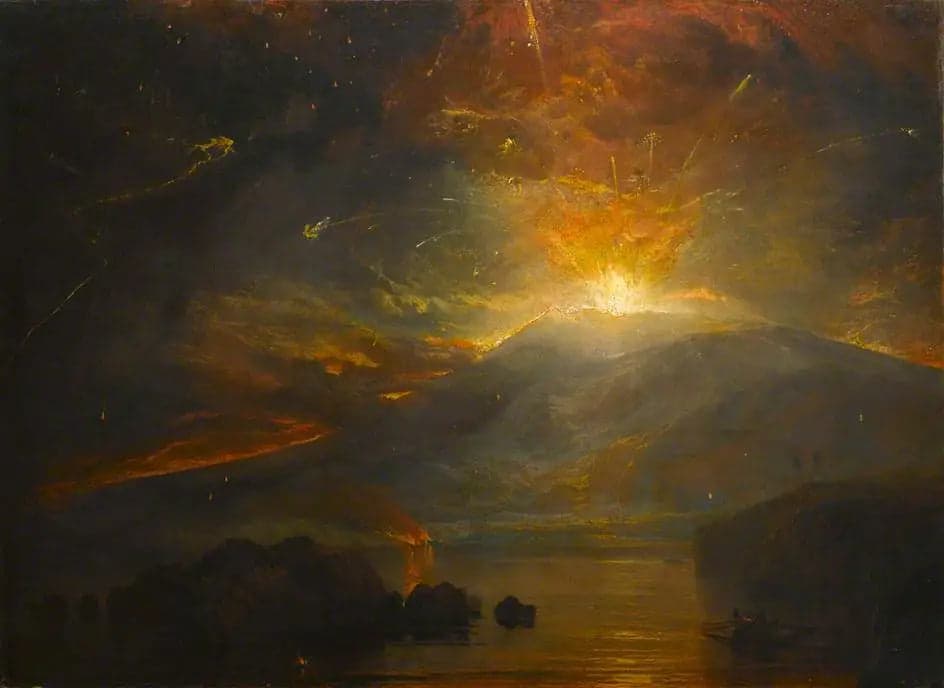
The Eruption of the Soufrière Mountains on the Island of St Vincent, 30 April 1812
- Original dimensions
- 105 x 79 cm
- Museum
- Victoria Gallery & Museum
- Year
- 1815
Scene depicted
This painting monumental depicts the explosive eruption of the Soufrière, enveloped in clouds of ash and smoke, illuminated by flashes of divine light. Streams of lava pour forth, paying homage to the immeasurable strength of the earth. The composition captures not only the destruction but also the disturbing beauty of a natural phenomenon, making this pictorial work a timeless masterpiece.
Historical context
Created in 1815, this painting evokes the power and beauty of nature through the prism of an exciting historical context. Turner, a key figure of British romanticism , transports us to 1812, the year of the mythical eruption of the Soufrière on the island of Saint Vincent. Today, the canvas resides at the Victoria Gallery & Museum, offering visitors a window into the tormented soul of nature.
Place in the artist's career
The creation of this painting occurs at a turning point in Turner’s career, symbolizing his quest to break free from academic conventions. At that time, he was also producing other canvases such as “The Fighting Temeraire” and “Rain, Steam and Speed,” reflecting his evolution towards emotional abstraction, where light and atmosphere take precedence over detail.
Anecdote
“Nature expresses what man hides.” It was while contemplating a misty morning on the edge of a cliff that Turner was inspired by the incandescent breath of volcanoes. At that precise moment, he let himself be carried away by the evocative power of the canvas he was about to create, forging an indelible connection between the artist and the suffering natural scene.