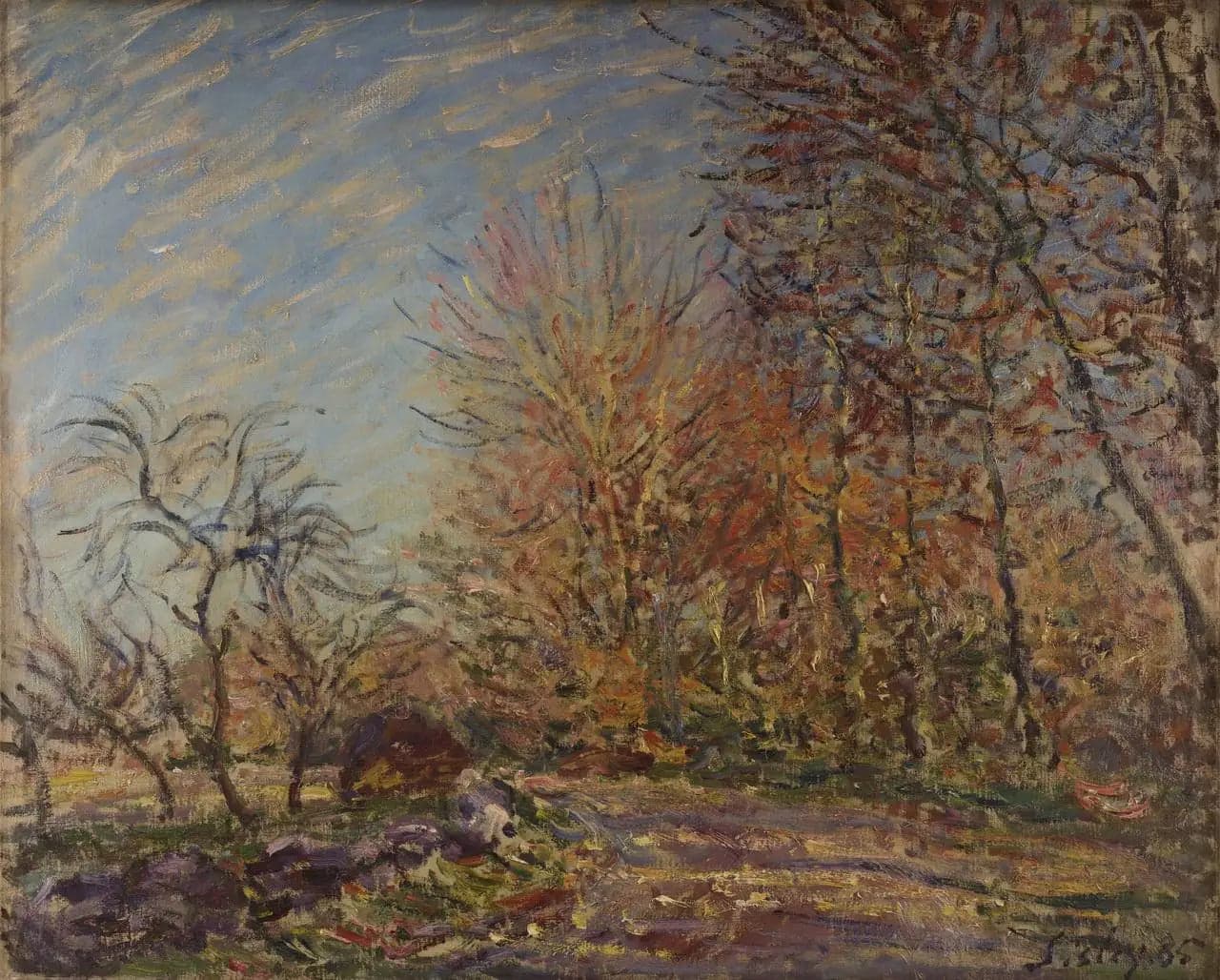
The Edge of the Forest of Fontainebleau
- Original dimensions
- 73 x 60 cm
- Museum
- Pushkin State Museum of Fine Arts
- Year
- 1885
Scene depicted
“The Edge of the Forest of Fontainebleau” evokes a suspended moment where nature reveals itself. This painting illustrates a bucolic scene, filled with shimmering greenery and majestic trees lining the path. Through its delicate brushstrokes, Sisley transports the viewer into a landscape where light plays hide and seek with shadows, creating a serene harmony.
Historical context
Created in 1885, this painting emblematic finds its place in the heart of the Fontainebleau region, a land rich in artistic history. It belongs to the Impressionist movement, which seeks to capture the light and atmosphere of a moment. Today, this canvas is preserved at the Pushkin State Museum of Fine Arts , made famous by its generous dimensions, 73 x 60 cm, which invite contemplation.
Place in the artist's career
This admirable canvas marks a turning point in Sisley’s career, representing both a moment of maturity and mastery of his art. In parallel, his works “Impression, Sunrise” and “The Seine at Argenteuil” show a dynamic evolution, from the blurry Impressionist style to the refined details of this painting .
Anecdote
Alfred Sisley once declared: “The beauty of nature is a call to immortalize its splendor.” This masterpiece was born on a vernal morning, where the soft murmur of leaves and the scent of flowers intertwined, inspiring the artist to capture this ephemeral vision in his canvas .