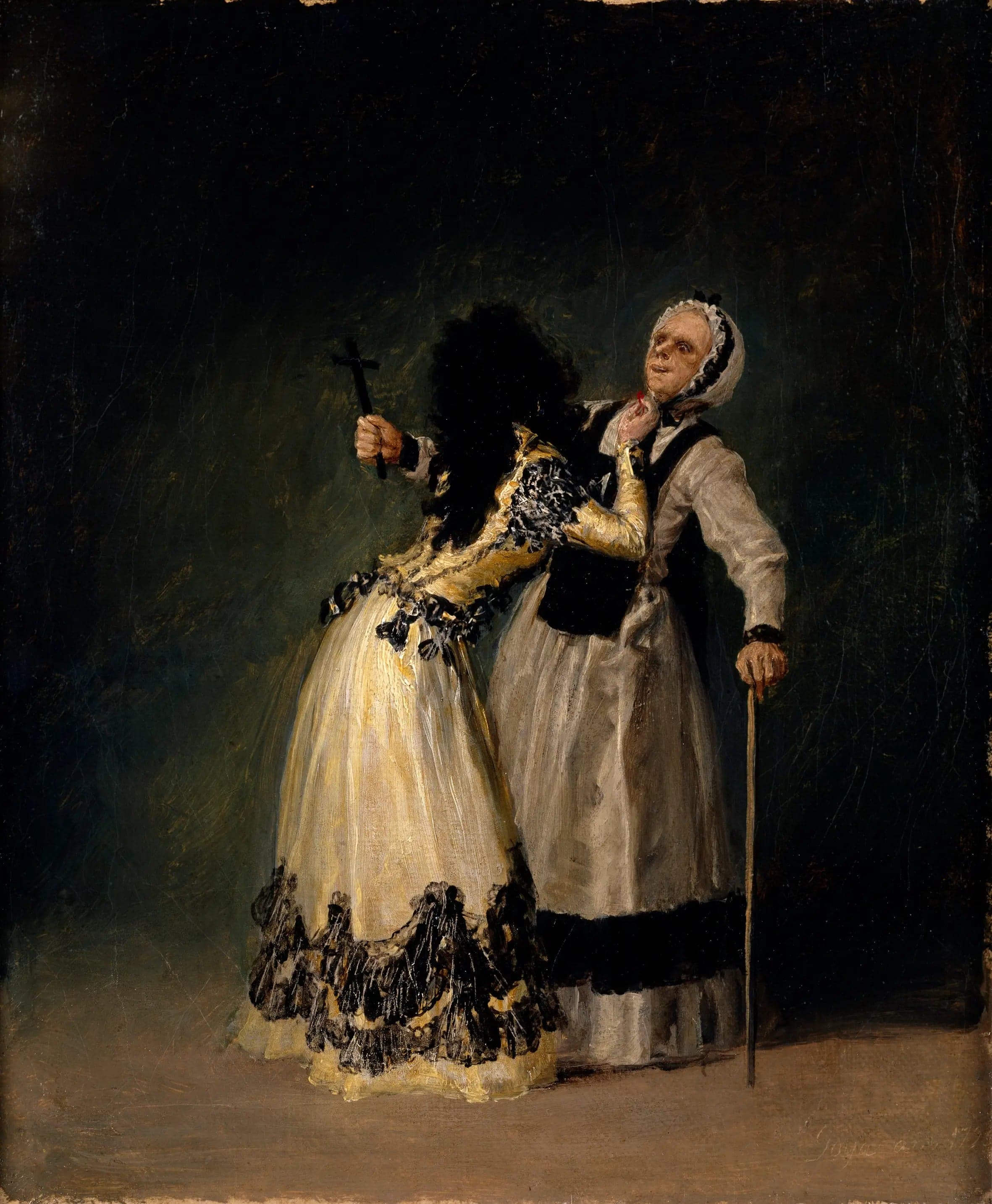
The Duchess of Alba and the Bigot
- Original dimensions
- 27.7 x 33 cm
- Movement
- Neoclassicism
- Museum
- Prado Museum, Madrid
- Year
- 1795
Scene depicted
This painting features a tall woman, the Duchess of Alba, dressed sumptuously, alongside a servant, more humbly dressed but equally fascinating. Goya captures the ethereal beauty of the duchess and contrasts her prestige with the discretion of her companion. The composition creates a silent dialogue, revealing the subtleties of social relationships and underlying human emotions. A scene imbued with palpable tension, where light illuminates the intricate details of the rich fabrics like revealed treasures.
Historical context
Created in 1795 in Madrid, at the heart of Spain, this painting emblematic of Francisco de Goya arises from a time marked by neoclassicism. This painting, currently preserved in the Prado Museum, illustrates not only the exceptional talent of the artist but also the social context of his time, where the layers of society intertwined. With modest yet powerful dimensions, this canvas testifies to a desire to capture the intimacy and complexity of human relationships.
Place in the artist's career
This painting, a marker of a period of maturity in Goya's career, stands out among his other works, such as The Naked Maja and The Family of Charles IV, for its intimate approach. While his previous paintings often evoked historical scenes, this one prioritizes the psychology of the characters, showing an evolution towards a more personal and introspective observation.
Anecdote
“The truth of a face lies in the reflection of the soul.” Thus spoke Goya, inspired by the morning light piercing through the streets of Madrid. It is in this vibrant atmosphere that he conceived his masterpiece , probably after crossing the gaze of a lady of the world, rooted in her time but also close in her concerns. This emotion of a fleeting encounter permeates every brushstroke of the canvas .