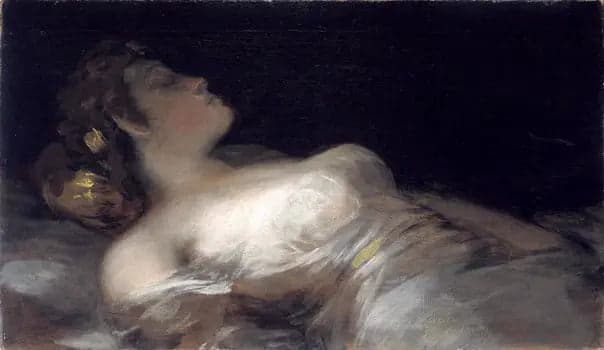
The Dream
- Original dimensions
- 76 x 46.5 cm
- Museum
- National Gallery of Ireland
- Year
- 1790
Scene depicted
In this painting , Goya immerses us in a dreamlike universe where the boundary between the real and the imaginary blurs. The representation of enigmatic floating figures and surreal landscapes creates an ethereal atmosphere, inviting the viewer to engage in deep reflection on the nature of dreams and unattainable desires.
Historical context
Created at the end of the 18th century, The Dream is one of the most evocative compositions by Francisco de Goya , a pillar of early romanticism . This painting is the result of a complex context in Spain, diving into an era of social and political upheaval. Currently housed at the National Gallery of Ireland in Dublin, this canvas measures 76 x 46.5 cm, showcasing unparalleled craftsmanship in the manipulation of colors and emotions.
Place in the artist's career
The Dream is situated at a pivotal moment in Goya's career, between his promising beginnings and his later, darker works. Through this canvas , he initiates a stylistic transformation that can be observed when comparing it to other paintings like The Clothed Maja and Saturn Devouring His Children. Each of these masterpieces reveals a technical evolution and an increasing emotional intensity.
Anecdote
“Art must translate our dreams before reality sweeps them away,” Goya might have said one morning while strolling through the fragrant gardens of the city of Madrid, inspired by the whispers of the wind and the vibrant colors of his surroundings. This moment suspended in time becomes the soul of The Dream , a pictorial work that explores the dimensions of the unconscious.